
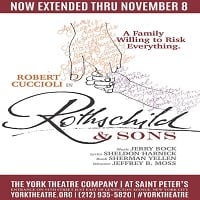
Who doesn’t have great respect and admiration for the musical team of Jerry Bock and Sheldon Harnick? Certainly no one who has seen and heard the great body of their work which includes She Loves Me, Fiorello! (Pulitzer Prize) and their master work Fiddler On The Roof which in its day was the longest running musical in the history of Broadway.
The Apple Tree was a highly imaginative departure in form, presenting three one act musicals in varied styles, and it managed a healthy 13-month run in New York and has been revived more than once. The Rosthchilds, as it was then known, was in that category — mixed, but good reviews and a run of over 500 performances, with a decidedly varied reaction from its audiences, which were mostly comprised of those who so adored Fiddler that they could not wait to buy seats to the next Bock and Harnick show. It took some persuasion for this hot team to agree to work on it, for they felt its concern with Jewish life in Europe was too close to Fiddler, and they didn’t want to return to the plight of the European Jews immediately. But they responded well to Sherman Yellen’s treatment in the book and they accepted Producer Hilly Elkins’ offer to join the creative team.
The show deals with the founding of the financial empire of the family and its growing political influence and its aid in funding Napoleon’s defeat under its patriarch . As the story unwinds, it concludes with their achieving a declaration of rights for European Jews in a time of great oppression. The young Mayor, married to a warm and supportive woman (Gutele), tells her his master plan is to rise from his simple role as seller of artifacts to leader of the pack that will close the ghettos into which the Jews of Europe must live under orders, and with great regulation set by the reigning royal houses. To do this he needs sons, five of them if possible, and that’s exactly what his wife provides over the next ten years.
The composer-lyricist and book writer Sherman Yellen have taken the material from the 1970 version, simplified its story line and transformed it into a one act piece that crams its ambitious story into 110 minutes of one act, with no intermission.They have also added a song or two, and the musical now boasts some 26 numbers including four reprises. On the trimming side, they have squeezed all this into the hands of eleven actors, where the musical once accommodated forty.
As a result, “production numbers” are limited to Mom, Dad, and the five sons, with the occasional assist of a prince or two. Mark Pinter, for example, plays three of these — William, Herries, and most prominently Prince Metternich, who is the most ardent opponent of Mayer Rothschild’s fight for equal rights for his people.
All through the evening, the writing presents Mayer and Gutele as a happy couple (five sons in ten years indicates some sort of harmony; agreed?) who battle only on the couple’s divergent views of how to define happiness. Mother Gutele makes it clear that all she needs is “One Room” as long as it’s filled with her loved ones. She is not in favor of Mayer’s grand plan to gain total equality and freedom for the Jews of Europe. He in turn explains how, with five “Sons,” he will be able to expand his influence and accomplish miracles. He not only battles Gutele, whom he loves, but his oldest son Nathan, as he matures, becomes another adversary, who does not have the patience of his father, and they have head on clashes. “What’s To Be Done?,” “Nathan’s Revenge,” “He Never Listens,” and “In My Own Lifetime” are all major anthems that repeat the various viewpoints musically.
Robert Cuccioli makes a splendid Mayer, using his crystal clear baritone, the one that helped so much to elevate Jekyll and Hyde when he starred in it some 18 years ago. He is perfectly cast as both the young dreamer with ambition to the patriarch who does not live to see his dream completely fulfilled, as well as the man whose faith in his sons’ abilities is unshakable.
Christopher M Williams is a formidable Nathan, the oldest son, the constant challenge to his father, though the love between them is palpable. Mr. Williams has discovered the strength in his character. He sings and plays him with almost too much conviction. I think he would be more identifiable if he located the lighter side of this young man.
The casting of the other brothers has little to do with making them plausible young sons to Mayer. There is no attempt at family resemblance, with regard to age, personality, ethnicity. Some thought has been given to casting the rest of the principals, but when it came to the sons, perhaps because each actor plays many incidental roles, caution was sent to the winds.
Glory Crampton is lovely as Mrs. Rothschild, managing even her voice and composure very clearly as she matures into middle age. She has a lovely voice, and she knows how to make something real out of the simplest gesture or nuance in delivering a lyric. Mark Pinter’s many princes are all evil, and the principal one, Metternich is the sort that earned hisses in the early days when we were all a lot more primitive. He’s effective, has found a correct center for his untrustworthy sample of royalty, but subtle he is not. His Metternich is more like the evil character in any of Disney’s animated films than he is a real live monster who might on occasion have something truthful or amusing to say on some subject or other. No, he is just big time mean.
The score by these two masters, is not from their top drawer. Nothing as memorable as “Ice Cream” from She Loves Me or “If I were A Rich Man”, “Sunrise, Sunset” and “Tradition” from Fiddler, or “The Little Tin Box” from Fiorello!. I realize there is little room for humor in Rothschild and Son — I don’t expect a “Boston Beguine” (New Faces of 1952) to pop up. I just mean those are iconic songs that will always be with me, and I can’t think of any from this score that will be the same. It’s clear that the authors have always been attracted to this material, and one can understand their desire to return to something they love with a fresh view, but I regret that in my opinion, though it would seem to be more appealing to regional theatres because of its loss of weight, I can only wish them well in finding a new life for it with this version.
Running Time: One hour and 50 minutes, with no intermission.
Rothschild & Sons plays through November 8, 2015 at The York Theatre Company – inside of Saint Peters Church – 619 Lexington Avenue (Corner of 54th Street), in New York City. For tickets, call the box office at (212) 935-5820, or purchase them online.