
Cat Stevens (as he was known then) last performed at The Kennedy Center back in November 1971 just months after it opened. Much has changed since then, including his name (which became Yusuf after he converted to Islam in 1977). But to his enraptured fans in the sold-out Concert Hall the other night, it was an ecstatic reunion with some of the most heartfelt and pure music about peace and love of this or any time.
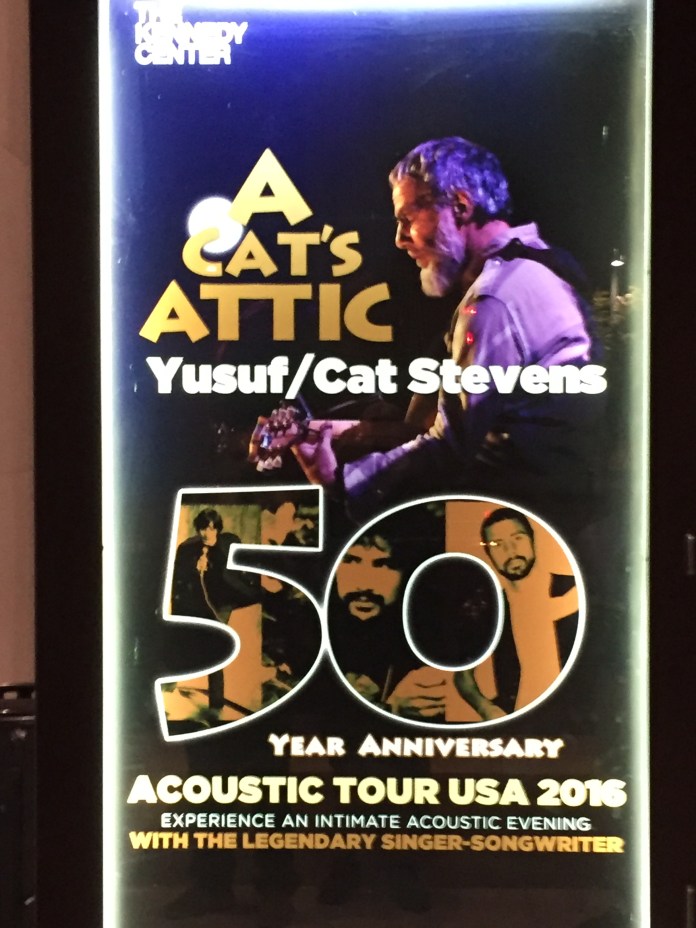
Yusuf / Cat Stevens’ “A Cat’s Attic” tour was not promoting an album—he was simply telling us through song the story of his life (“Welcome to my background,” he said gently near the beginning). Thus the entire evening was blessedly devoted to such beloved classics as “Where Do the Children Play?” “Moonshadow,” and “Peace Train.” The crowd seemed to savor every familiar measure, every emotional moment of it. Songs were greeted throughout by individuals standing up as if in personal exultation, even before mass praise poured out in ovations at the end.
The stage set, he tells us, evokes the attic above his parents’ home in London’s West End where he grew up. The backdrop is a moonscape. Shining stage left as if on a foggy night is a street lamp under which his two backing musicians will play. And inside the quaint wooden attic itself are a comfortable chair, an old trunk, a vintage record player, an upright piano, and posters on the wall, one of himself from his early years and one for West Side Story. Turns out as a boy he could hear the show down the street from this room, and he became a fan of musicals, as he tells us just before singing “Somewhere.”
The amiable evening proceeds like that, each song introduced by autobiographical patter that positions it in his lifetime (and, for many in the audience, ours). In his dashing gray hair and beard, wearing an easygoing vest and T, he stands or sits relaxed at a mic and sings for us, his guitar playing virtuoso. His voice is clear and strong as it’s ever been, focused and unforced from his head notes to his bass. He makes the whole house feel at home.
He cites the Beatles’ influence on him—”Have fun, sing, and fall in love”—then renders a bouncy “Love Me Do.” Offering us his own 1967 “Here Comes My Baby,” he mischievously inserts “text on the phone” into the lyrics. Sitting beside the phonograph and playing a track of “Twist and Shout,” he remembers, “I had to get myself a guitar after that.” Continuing on the theme of songs of longing from his love-struck youth, he elicits cheers from the audience with “The First Cut Is the Deepest.”
His wit shines through often, as when singing and playing “Matthew and Son,” he lets us hear how his song’s hook is echoed in the “think it’s kinda funny” refrain of “Mad World”: “Well, I think it’s kinda funny,” he quips, “how this sounds the same.”
From an early age, he tells us, he was really into musicals and has made several unfinished attempts to write one, including an anti-violence musical titled The Death of Billy the Kid. In the second act when he sings his emotionally powerful “Father and Son,” which brought the audience to its feet, he informs us it originated for a musical be worked on with Nigel Hawthorne called Revolution. The song is about a pacifist father trying to dissuade his son from leaving home and joining up, and the son saying why he must go his own way. The high-stakes context of that unfinished musical gives the song stunning new resonance.
https://youtu.be/jQPeGFcmLEo
His life story took a dark turn when he was hospitalized with TB, “a big wakeup” after which he sought spiritual solace in Buddhism and went to India, the occasion for his lovely “Katmandu.” Then just before intermission he foreshadows his later religious conversion with a moving rendition of “On the Road to Find Out”:
Yes the answer lies within
So why not take a look now
Kick out the devils sin
Pickup, pickup a good book now
In Act Two we find him sitting at a table pouring tea for himself, in fond remembrance of the cover art he drew for his album Tea for the Tillerman, where many of the evening’s most revered songs first appeared. He moves to the piano where he accompanies himself on a tender “Sad Lisa” and hearkens back to the soundtrack ofHarold and Maude with a rousing “If You Want to Sing Out, Sing Out.” His lyrics can sometimes be so childlike, his couplets so truthful and touching.
Introducing his erotic fable “Boy With a Moon and Star on His Head,” which contains lyrics atypically graphic for this devout period of Yusuf’s life (“It is you I want to share my body with”), he first assures the audience that “nothing in this song ever happened.” Then he adds, joking: “I hope that message gets back to my wife.”
His spiritual, personal, and professional life pivoted dramatically on a trip to Rio in the 1970s during “a dark period in my life.” He was swimming in the ocean and a strong Pacific current was pulling him out to sea. “I asked God to save me,” he tells us. “And He sent a wave.” That wave carried him safely to shore—and propels him into “People Get Ready”:
People get ready
There’s a train a-coming
You don’t need no baggage
You just get on board
All you need is faith
To hear the diesels humming
Don’t need no ticket
You just thank the Lord.
His brother gave him a book, he tells us, “a book about Abraham, Moses, Jesus.” Though he never names it, we know he means the Quran. “I learned to bow,” he explains. “To be what you must, you must give up who you are.”
A long period followed, nearly three decades, during which Yusuf neither composed nor performed anymore. To the world he was becoming a great humanitarian, giving of the wealth he’d earned in the music industry he now eschewed to rescue orphans and other refugees. But to his thongs of fans he had fallen silent.
Then one day his son brought a guitar back into their home. “The guitar came back,” he says simply, “and I realized I really had another job to do.”
Besides growing up on Broadway musicals, Yusuf also was drawn to Disney. That turns out not to be so improbable as he quotes a rabbit in a Disney movie called Zootopia who gives a speech to the other animals that goes in part,
Try to make the world a better place…. Change starts with you, it starts with me, it starts with all of us.
Acknowledging he is performing this night at the epicenter of American politics, he is careful not to inject himself into election season. “I’ve decided to say—nothing,” he says drily. “Except I vote for the rabbit.” And with that he launches into his unstoppable “Peace Train.”
His encores of “Wild World” and “Morning Has Broken” became in that cavernous hall an audience singalong. And when at last he left the stage saying “Peace be with you, my friends,” it was like an actual benediction.
One of the big takeaways of the evening was what a gift Yusuf / Cat Stevens’ extraordinary song catalog would be to musical theater if someone could get it right. There was a disastrous attempt made in Australia called Moonshadow, which closed promptly. But if it could work with ABBA’s Mama Mia and Green Day’s American Idiot, it sure ought to work with Yusuf / Cat Stevens.
I am someone for whom Cat Stevens’ music was on the sound track of my youth. I choke up hearing “Morning Has Broken” the way I do hearing “Imagine” or “Amazing Grace.” Listening to him sing with such soulful beauty and pacifist conviction again brought me back to a time of tender hope and inspiring optimism that I’d long forgotten—and that I realized our nation too has been missing.
I recommend taking some time from your life to listen to Yusuf / Cat Stevens, again or for the first time. He’s a genius gentle treasure, and as a troubadour for our troubled times, he’s indispensable.
Set List
“Where Do the Children Play?”
“Don’t Be Shy”
“Somewhere” (P.J. Proby cover)
“Love Me Do” (Beatles cover)
“Here Comes My Baby”
“The First Cut Is the Deepest”
“I Love My Dog”
“Matthew and Son”
“A Bad Night”
“Trouble”
“Fill My Eyes”
“Katmandu”
“I Wish, I Wish”
“Miles From Nowhere”
“On the Road to Find Out”
Intermission
“Sad Lisa”
“If You Want to Sing Out, Sing Out”
“Into White”
“Father and Son”
“Moonshadow”
“How Can I Tell You”
“Sitting”
“Boy With a Moon and Star on His Head”
“Ruins”
“Oh Very Young”
“Novim’s Nightmare”
“People Get Ready” (Impressions cover)
“Be What You Must”
“Roadsinger”
“Maybe There’s a World” / “All You Need Is Love” (Beatles cover)
“Peace Train”
Encores
“Wild World”
“Morning Has Broken”
Running Time: Two hours and 30 minutes, including one intermission.
Yusuf / Cat Stevens’s A Cat’s Attic tour played September 22, 2016 at The Kennedy Center Concert Hall — 2700 F Street, NW in Washington, DC. Tickets for remaining tour performances are available online.
RATING: