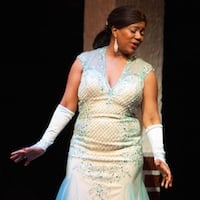
“These are my friends,” Billie Holiday (Anya Nebel) tells her accompanist (LeVar Betts), gesturing at the audience. It is March of 1959, and Holiday will be dead in four months. She’s singing at Emerson’s Bar & Grill, in Philadelphia, a city she doesn’t care for at all; but what Holiday is really doing is both an exorcism and Last Rites for herself.
Nebel is haunting as Holiday in Anacostia Playhouse’s Lady Day at Emerson’s Bar & Grill, drinking her way through songs and memories that keep bubbling to the surface: how her mother came to be called Duchess. The terrible men in her life. How she came to sing the way she did. The terrible toll drugs had on all her relationships. The overt racism that barred her from white clubs. (The noxious fluidity of privilege, however, allowed white people to throng to black clubs for the better music, better dancing, and genuine passion for music. Afterwards, though, those white people could just as easily throng right back out of that environment without doing any work to better acknowledge the artists they loved.) Nebel’s voice is warm and supple, backed by a three-man group with Betts on piano, Mike Pugh on bass, and Sedale McCall on drums. If Nebel doesn’t sound perfectly like Holiday, that’s not the point. What she conveys perfectly – whether it’s through her singing, through her stories, or through her wearied but dirty laugh – is Holiday’s brave vulnerability. “Singing is how you feel!” Holiday exclaims. And she has felt everything.
Jonathan Dahm Robertson’s set design is intimate perfection. Stepping from the lobby into the theater, you’re stepping from the present into a dark, swanky, and probably a little gritty (if the lights were on) past, hazed in smoke. Tables for two litter the floor (the best seats in the house if you get there early enough), each with a small candle lamp. And Billie Holiday herself will take the stage, in a gorgeous spotlight (John D. Alexander’s lighting design is intuitive and intelligent, keeping Nebel cloaked in a comforting darkness at one point, bathing her in silver light the next) at the top of the stage.
Lady Day at Emerson’s Bar & Grill allows Holiday the chance to tell “her friends” – those of us in the audience – her life story: where she came from, how she discovered singing, how she discovered a catalog of ugly double standards, how she found each of the terrible men in her life, and how she lost most of it by 1959. Heroin, alcohol, and a heart quicker than her brain in love are culprits – but also an industry that saw black talent and black creativity as wells to tap but never replenish. If the men in her life used her up, a society that expected black women to never need a restroom in a jazz club, or to be taken seriously, or to be paid, needs to be offered as suspects as well.
Lady Day offers Nebel the chance to work through some of the better-known songs from Holiday’s songbook: the apologetic “Crazy He Calls Me,” the instructive “T’ain’t Nobody’s Business,” or the modern and chilling “Strange Fruit,” to name some notable moments from the show. It also offers a context for the songs that might not have been apparent for first-time viewers. (This is a second-run of this performance – which means some are getting another chance to be blown away by Nebel.)
The anniversary of Billie Holiday’s death is July 17, 2017. She asks that we all take a moment, “and listen to my records on the radio.” Seeing Nebel’s transformative performance goes one better.
Running time: 90 minutes, with no intermission.
Lady Day at Emerson’s Bar & Grill plays through August 6, 2017 at Anacostia Playhouse – 2020 Shannon Place SE, in Washington, DC. For tickets, purchase them at the door, or online.