
Miss Saigon is all grown up. Sort of. It’s been almost 30 years since Alain Boublil and Claude-Michel Schonberg’s blockbuster opened in London’s West End and took the world by storm. But times have changed. And while watching the “new” production of the show that just landed at the Kennedy Center, it seems Miss Saigon hasn’t held up as well as one would have hoped. The big songs and grand moments are still there, but it all seems a bit hokey now. It’s sort of like watching a favorite tv show decades later and finding the whole thing kind of silly. Because, although we have grown and changed, Miss Saigon hasn’t. It’s predictable and familiar. And that’s precisely the problem.
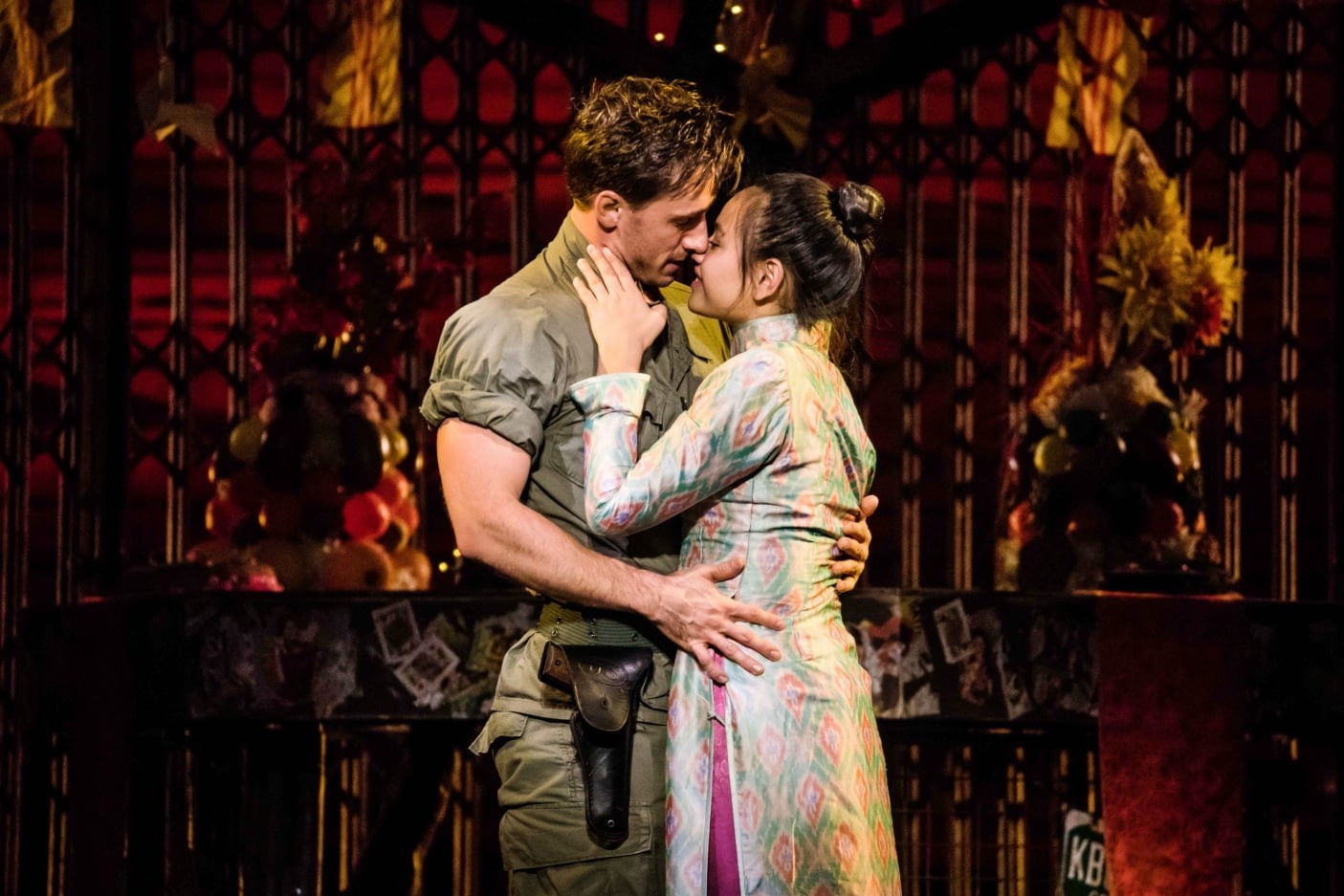
Loosely based on Giacomo Puccini’s Madama Butterfly, and set at the end of the Vietnam War, Miss Saigon is the story of Kim (Emily Bautista), a South Vietnamese girl, and Chris (Anthony Festa), the American GI she falls in love with on the eve of the fall of Saigon. Three years later, Kim has given birth to a child, Tam (Chris’s son) and is now working as a dancer in a seedy bar in Bangkok. She lives with the hope that the American soldier will return and take her to America. On the other side of the world, Chris is now married to a woman named Ellen (Stacie Bono) but remains haunted by his time in Vietnam and the love he left behind.
This Miss Saigon, which opened at the Kennedy Center this past week, is the 2017 Broadway revival, a reimagined staging directed by Laurence Connor, although it did not seem so terribly different than the original production that I saw in London 23 years ago. Mr. Conor hasn’t ushered Miss Saigon in to the 21st century. Rather, his production seems sort of stuck in the early 1990s. And by failing to make this piece relevant, Mr. Conor hasn’t really made a compelling case to justify this revival.
Miss Saigon is larger than life. There is little subtlety or nuance. Its plot has more holes than swiss cheese. Its characters are mostly types rather than fully fleshed out people. And that’s fine. Great actually. It retains many elements of the best opera. But we have little reason to care now. Conor’s production is big just for the sake of being big. As they say, “there’s no there there.”
This is not meant to give short shrift to the many wonderful elements on display here. Emily Bautista is thrilling as Kim. She has a powerful, rich voice and clearly conveys the timidness of Kim that gives way to strength. Red Concepcion is a revelation in the pivotal role of The Engineer. The Engineer is an unsavory fellow, a pimp, a petty criminal who functions as a sort of master of ceremonies. As played by Mr. Concepcion, The Engineer commands every moment he’s on the vast stage at the Kennedy Center Opera House. He possesses the broad style, the flair and, elan, that the material requires.

The set is appropriately dark and battered. But the costumes look as if they’ve never been off a hanger, let alone through a war. Special mention must be made of Bruno Poet’s exceptionally evocative lighting. Filtered through what appear to be grates, when the characters refer to Saigon as hell, Mr. Poet’s lighting suggests that that is exactly where we are.
Miss Saigon speaks to so many issues that are relevant today: immigration, the subjugation of women, America’s role on the world stage. As an introduction to the material, this production is satisfactory, if not particularly exciting. But I was hoping for so much more.
Miss Saigon plays through January 13, 2018, at the Kennedy Center Opera House — 2700 F Street NW in Washington, D.C. For tickets, call the box office at (202) 467-4600 or purchase them online.
Running Time: Two hours and 40 minutes, including one 20-minute intermission.
With Emily Bautista, Stacie Bono, Red Concepcion, J. Daughtry, Anthony Festa, and Jinwoo Jung. Lighting design by Bruno Poet; Projections by Luke Halls; Sound design by Mick Potter; Costume design by Andreane Neofitou; Design concept by Adrian Vaux; Production design by Totie Driver and Matt Kinley; Musical Staging and Choreography by Bob Avian; Additional Choreography by Geoffrey Garratt.