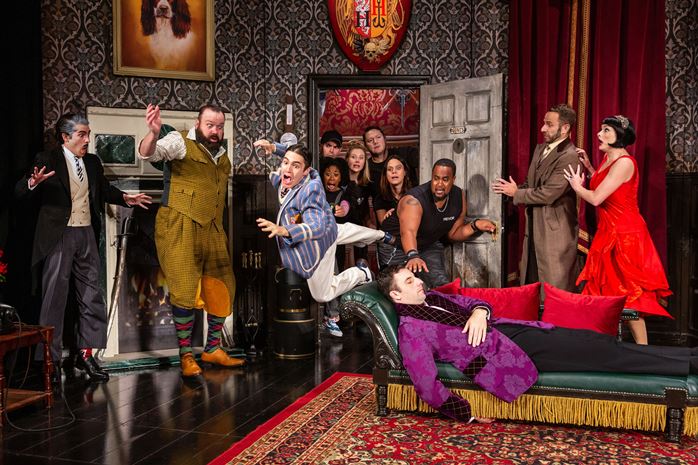
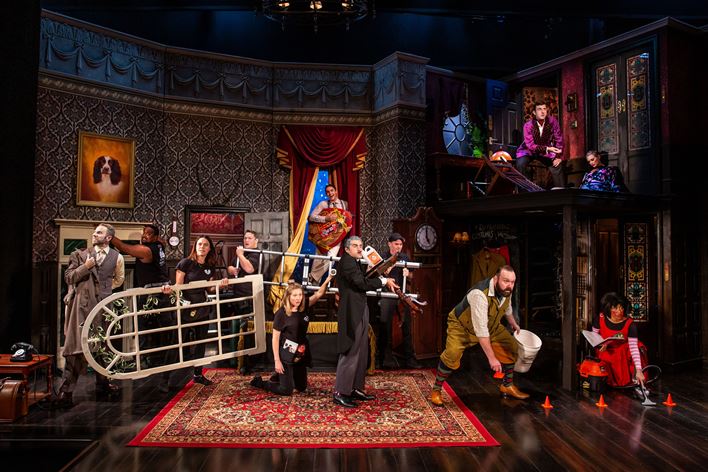
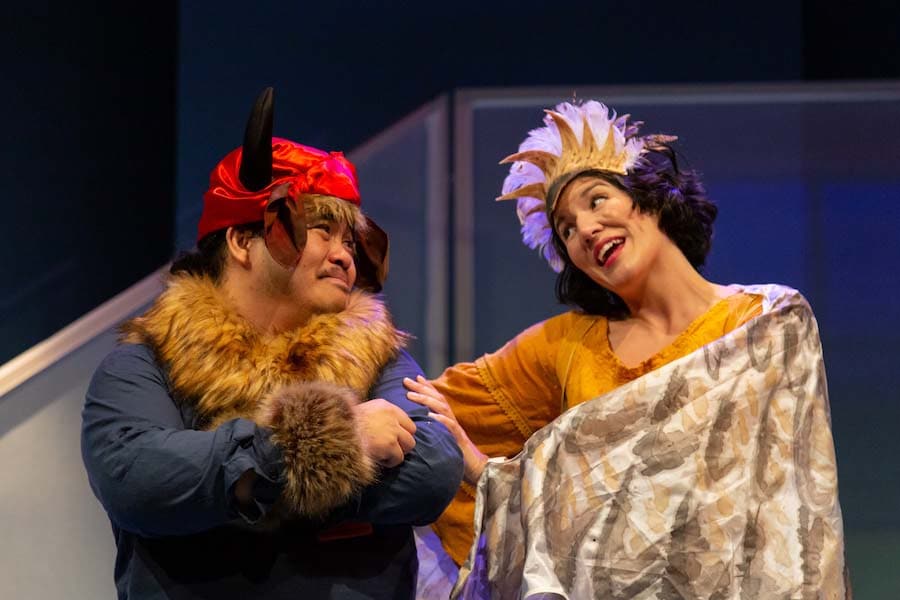
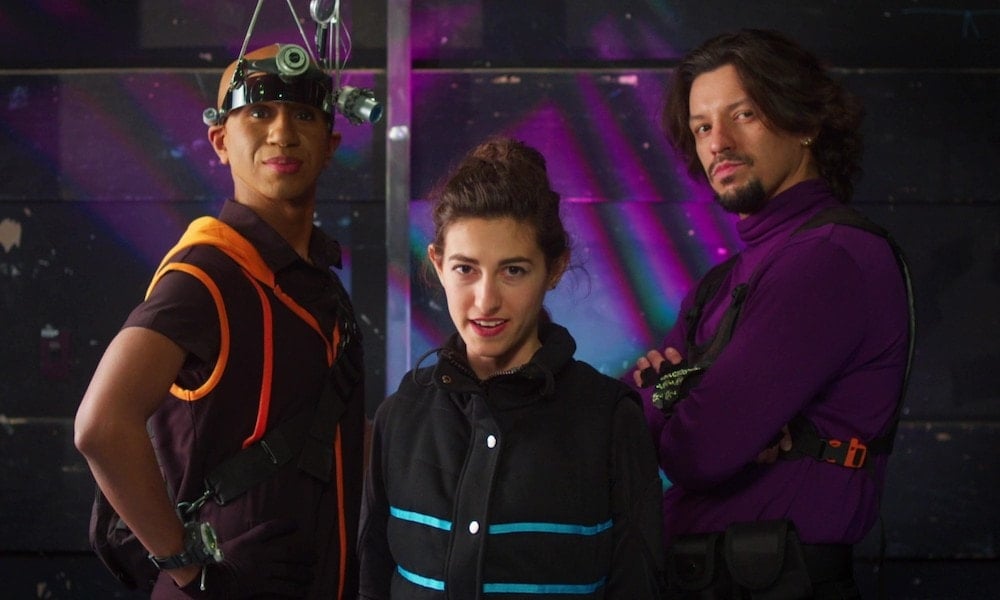
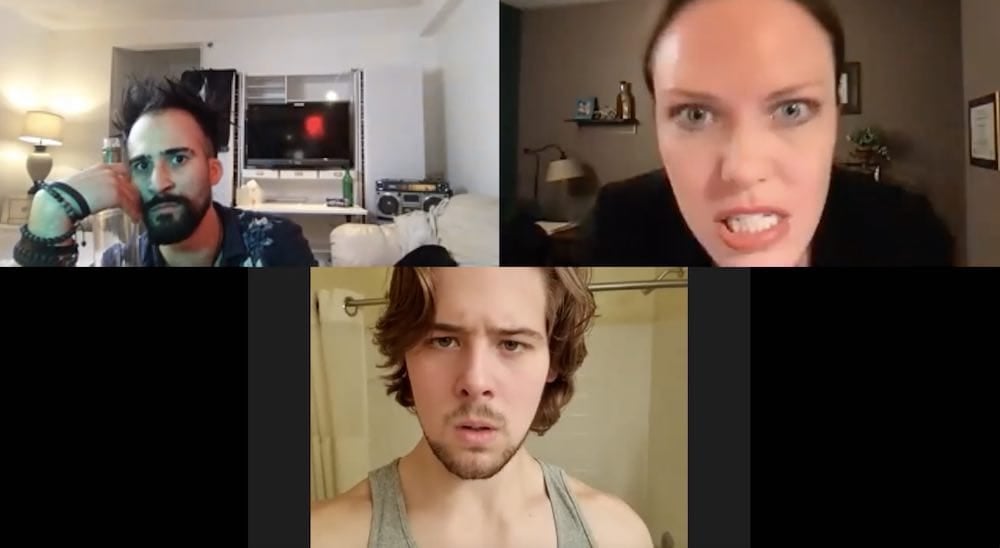
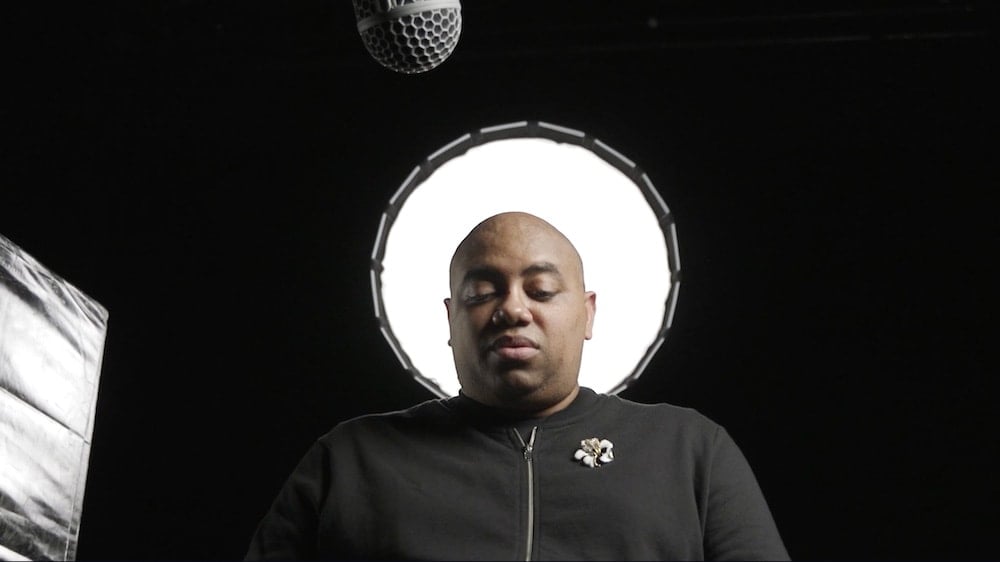
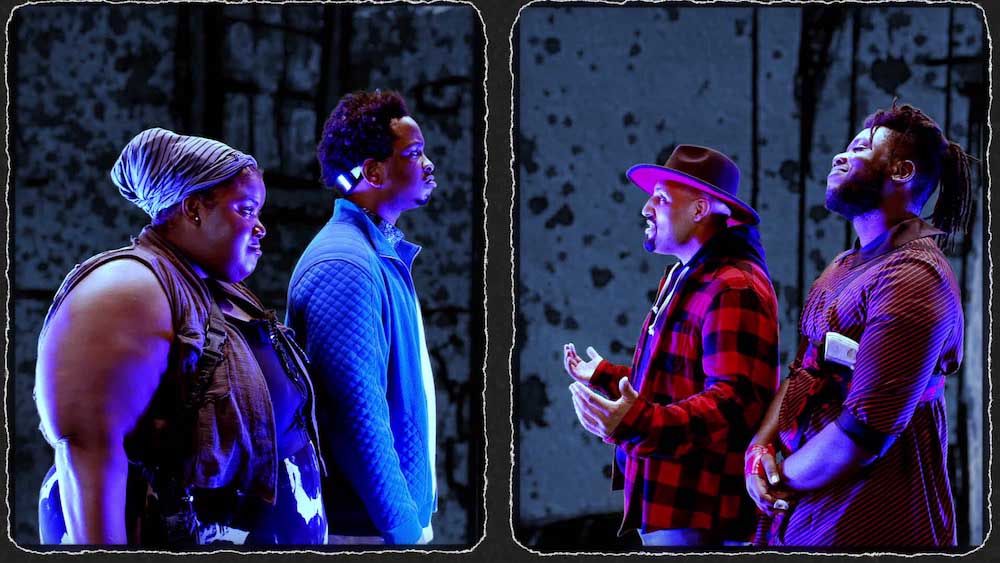
As the year draws to a close, we asked DCMTA writers to think back on the productions that left an impression on them in 2021.
Here are the community theater productions that resonated with our writers this year.
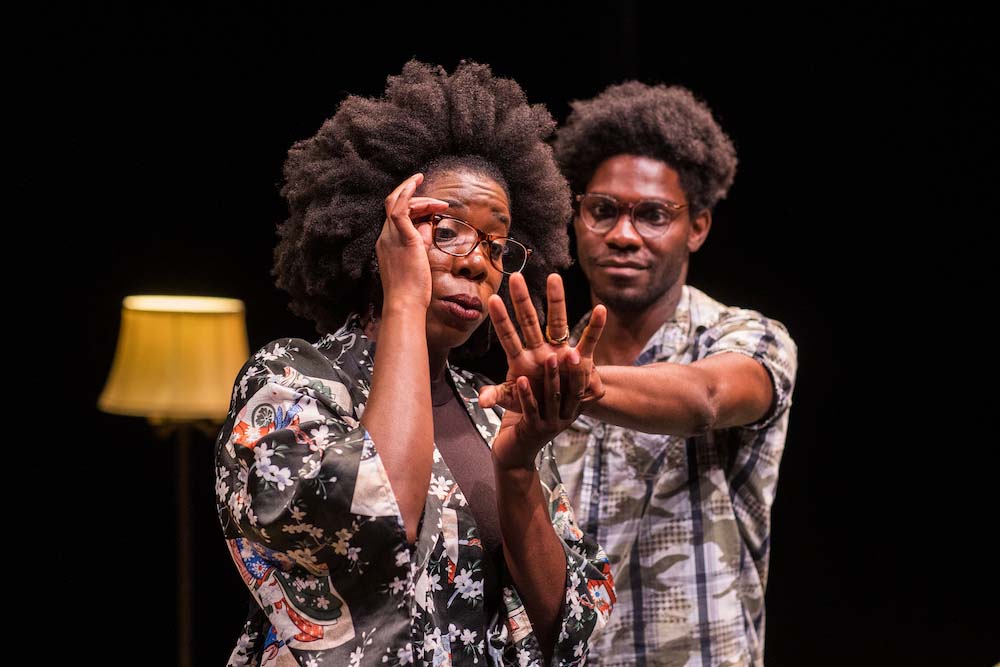
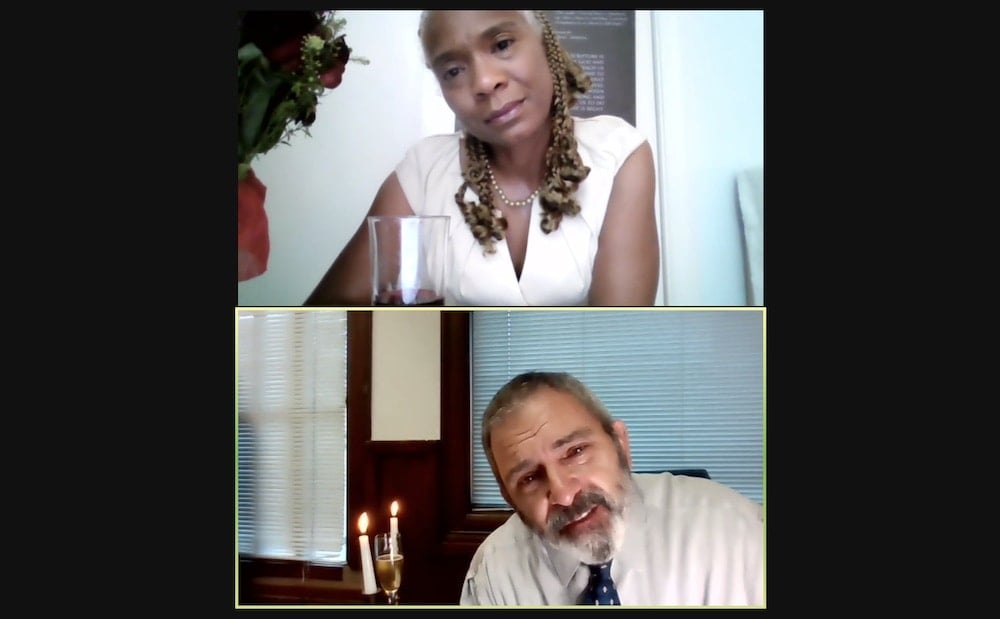
Melvin D. Smith as Harold and Paul Brewster as Albie in ‘A Black and White Cookie.’ Photo by Harvey Levine.
A Black and White Cookie, Silver Spring Stage
Originally programmed as a staged reading with scripts in hand, the October 15–17, 2021, A Black and White Cookie evolved into a minimally produced show under the direction of Jacqueline Youm. It was Silver Spring Stage’s first live performance at its storefront theater in 18 months. Principal performers Melvin D. Smith as Harold, white-bearded Paul Brewster as Albie, and Youm as niece Carol each find a heart center of their individual characters. The supporting ensemble included Robert Howard and Helen Cheng Mao. Lisa Traiger’s full review
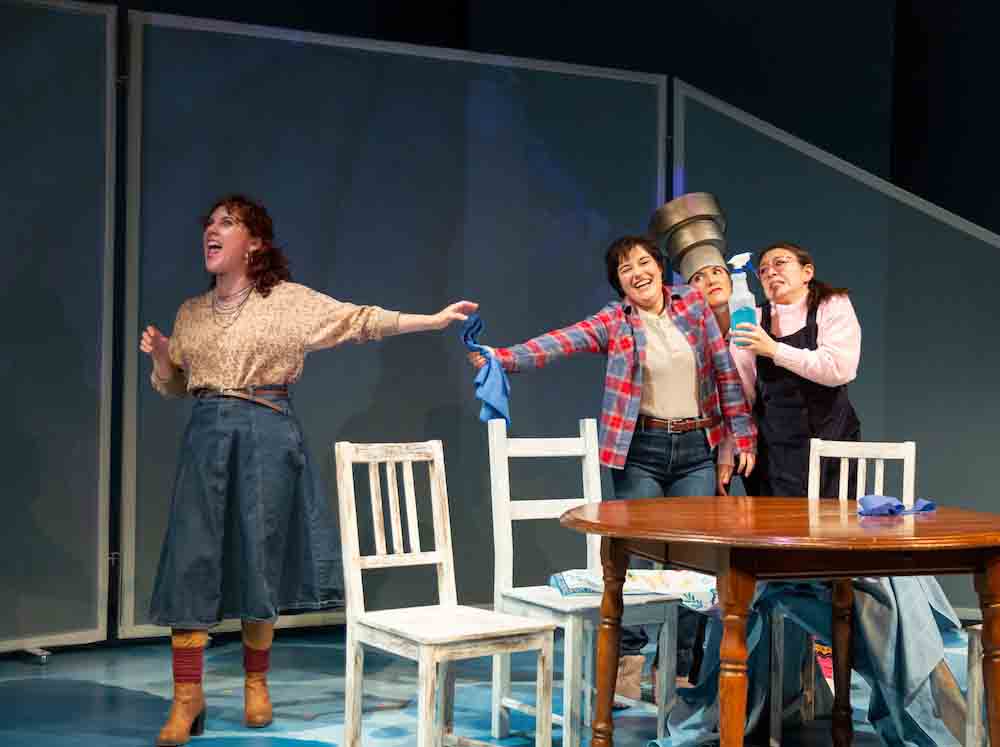
Gabby Carter (Mindy), Melanie Kurstin (Georgeanne), Rebecca Cooley (Frances), and Brittany Washington (Trisha) in ‘Five Women Wearing the Same Dress.’ Photo by Matthew Randall.
Five Women Wearing the Same Dress, Dominion Stage
Full of snark and sass, Five Women Wearing the Same Dress is packed with observations about women’s lives, bodies, deliberations, hidden secrets, and over-the-top revelations. The show is full of laugh-out-loud moments as bridesmaids wrestle with their demons of regrets past and current and potential future realities. Debbie Minter Jackson’s full review
Laura Gayvert as Lizzy and Ben Carr as Jack Key in ‘Maytag Virgin.’ Photo by Brandon Bentley.
Maytag Virgin, The Colonial Players of Annapolis
Audrey Cefaly’s play, about two neighbors in an Alabama town, is a quietly touching drama of intimacy and relationships. Edd Miller does a wonderful job as director, making the physical distance between the actors feel natural. They navigate the stage well and help create the illusion that only the two of them are there. Laura Gayvert gives an inquisitiveness to Lizzy. Ben Carr plays Jack with an independence that hides deep pain and feelings. After a year of their stage being dark, seeing the Colonial Players stage a full production is a joy. Charlie Green’s full review
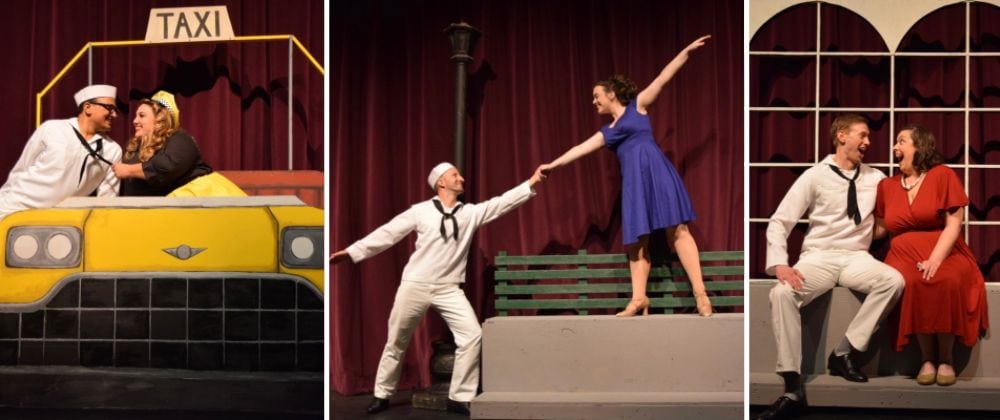
Scenes from ‘On the Town.’ Photos courtesy of Rockville Musical Theater.
On the Town, Rockville Musical Theatre
Rockville Musical Theatre’s production is absolutely top-notch, succeeding in every aspect of a show that is demanding of its cast and staff at a professional, let alone community, theater level. Watch Award judges should be watching. On the Town, written when its creators were in their mid-20s, is all about youthful energy, as the sailors do their best to squeeze every bit of life out of their short time in New York. World War II is in the background, but the show’s sights are fixed on the joy of living this day — joy that the Rockville Musical Theatre production abundantly gives to the audience. Bob Ashby’s full review
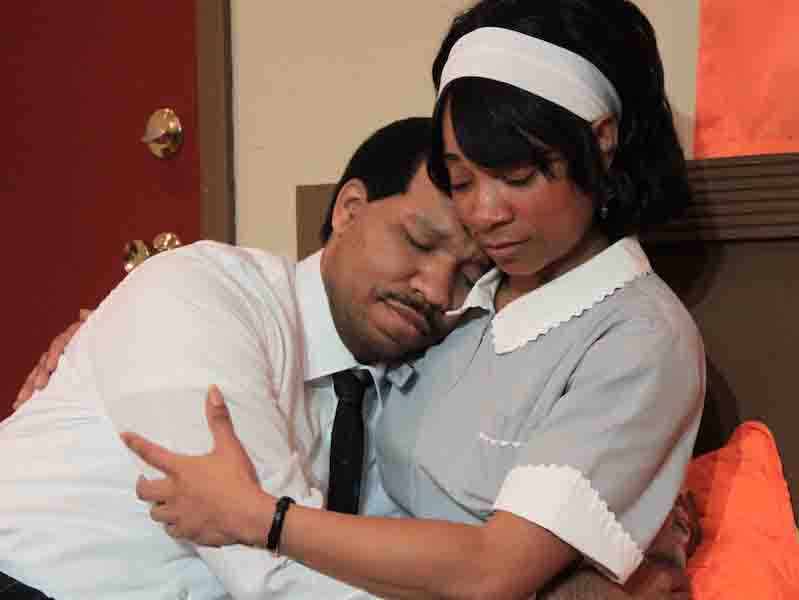
Robert Freemon (Dr. Martin Luther King Jr.) and Zenia McPherson (Camae) in ‘The Mountaintop.’ Photo by Ken Kemp.
The Mountaintop, Rockville Little Theatre (streaming production) The Mountaintop by Katori Hall, presented by Rockville Little Theatre in partnership with the City of Gaithersburg (Arts on the Green), takes place at the Lorraine Hotel in Memphis, Tennessee, the night before the assassination of Dr. Martin Luther King Jr. on April 4, 1968. In RLT’s virtual production of The Mountaintop, Robert Freemon’s Dr. King is clearly exhausted and doubting his own mission. He’s in a small hotel room, with orange beds and spartan décor. He paces back and forth, trying out phrases for a speech and checking the phone for listening devices. He is joined by the spirited and charming Camae (Zenia McPherson), a maid who brings him coffee and shares her Pall Malls. Both are charismatic, and both are on edge. It’s a beautifully produced and performed production. Sophia Howes’ full review
Carey Bibb, Samantha McEwen Deininger, Mary Rogers, and Ryan Harris in ‘The Revolutionists.’ Photo by Brandon Bentley.
The Revolutionists, Colonial Players of Annapolis
Directed by Jennifer Cooper, this French Revolution-era exploration of the lives of women is affecting and illuminating. The Revolutionists opens on the apartment of Olympe de Gouges, a writer and social activist, played by Mary C. Rogers. As the first act proceeds, we are greeted by two figures who loom large in French history: Marie Antoinette (Ryan Gunning Harris) and Charlotte Corday (Carey Bibb). The fourth character is Marianne Angelle — played by the stunning Samantha McEwen Deininger — who did not exist in fact but is a composite character representing free Black women on the island of Saint-Domingue. The acting and content are a highlight of this production. There is much else to love here, especially the set by Richard Atha-Nicholls and costumes created by Amy Atha-Nicholls. There are a number of technical effects that utilize projections. Designers Wes Bedsworth and Bill Reinhardt have done an excellent job of utilizing the technology available to them and the 360-degree space in which they are working. Darby Dejarnette’s full review
Dorothy (Allison Meyer), Lion (Meghan Williams Elkins), Scarecrow (Kathy Suydam), Toto (Amanda Dullin-Jones), and Tin Man (Francis Hoag). Photo by Kim Harmon Photography.
The Wizard of Oz: A British Panto, The British Players
Audience participation isn’t just suggested in British Pantos; it is delightfully mandatory. The British Players’ production of The Wizard of Oz was a top-notch production and a fun, loud, and raucous way to experience theater. Written by Emma Houldershaw and Samantha Cartwright, this is not the musical version of The Wizard of Oz that you have likely seen on stage or screen. Yes, it has songs, and yes, your favorite characters are there — including Dorothy and Toto, the Lion, the Tin Man, and the Scarecrow — but they are joined by an array of additional characters who amp up the humor of the show. Kudos are due to Director Nicola Hoag and to the entire cast and crew for this top-notch production. Nicole Hertvik’s full review
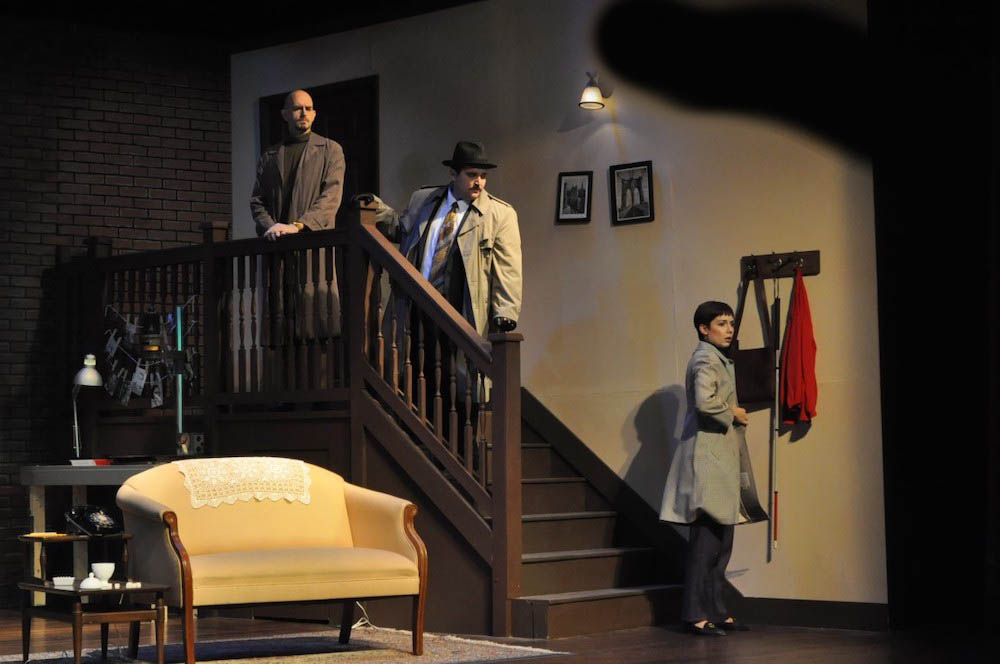
Adam Adkins (Roat), Brendan Chaney (Carlino), and Mel Gumina (Susy) in ‘Wait Until Dark.’ Photo by Matthew Randall.
Wait Until Dark, Little Theatre of Alexandria
The Little Theater of Alexandria (LTA) shows that good acting and taut direction can continue to fuel an entertaining production of Wait Until Dark, a 1960s thriller by Frederick Knott. Mel Gumina brings a consistently high level of energy to the lead role, Susy Hendrix. Any good thriller needs a villain, and Harry Roat (Adam R. Adkins) is as villainous as they come. Roat’s henchmen in the criminal scheme — the MacGuffin driving the plot is the search for a heroin-filled doll — are Mike Talman (Brendan Quinn) and Sgt. Carlino (Brendan Chaney), a couple of down-on-their-luck petty crooks. Director Heather Benjamin has created a taut and suspenseful production. LTA’s technical work is up to the group’s well-established standard. The realistic set, designed by Julie Fischer, pictures a quite high-ceilinged basement apartment, with frequently used stairs coming down from an upper entrance (footfalls on the stairs are an important plot device at times). Bob Ashby’s full review
Ovations Theatre
Special mention to Ovations Theatre for continuing to grow during COVID and producing high-quality productions featuring talented young performers. Ovations’ work provided a much-needed outlet for teens in 2021. Under the leadership of founder Darnell Morris, productions including Rent, Ragtime, Beauty and the Beast, and American Idiot featured stellar sets and costumes, and strong performances from Ovation’s young performers who are gaining a strong education in musical theater history and performance. In addition, Ovations grew into a permanent performance space, “the Harriet,” in Gaithersburg, Maryland — a challenging milestone for a growing theater company even if COVID were not a consideration. Nice work, Ovations! Read about Ovations Theatre
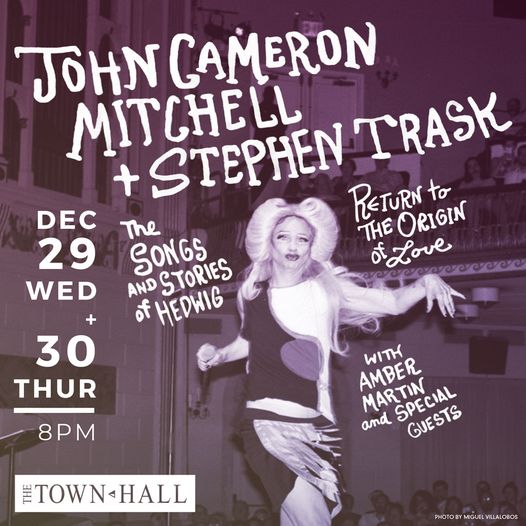
With its huge cult following of “Hed-heads” and significant place in both theater and LGBTQIA history, the four-time Tony Award-winning alt-culture musical Hedwig and the Angry Inch by John Cameron Mitchell (writer, director, and lead actor) and Stephen Trask (composer and lyricist) has continued entertaining and inspiring audiences since its Off-Broadway premiere in 1998, Broadway debut in 2014, 2016 US national tour, hundreds of regional and international productions, and 2001 film adaptation. It also provided the inspiration for the 2019 punk-rock concert spectacle Return to the Origin of Love: The Songs and Stories of Hedwig by the show’s co-creators, in honor of that year’s PRIDE50 celebration.
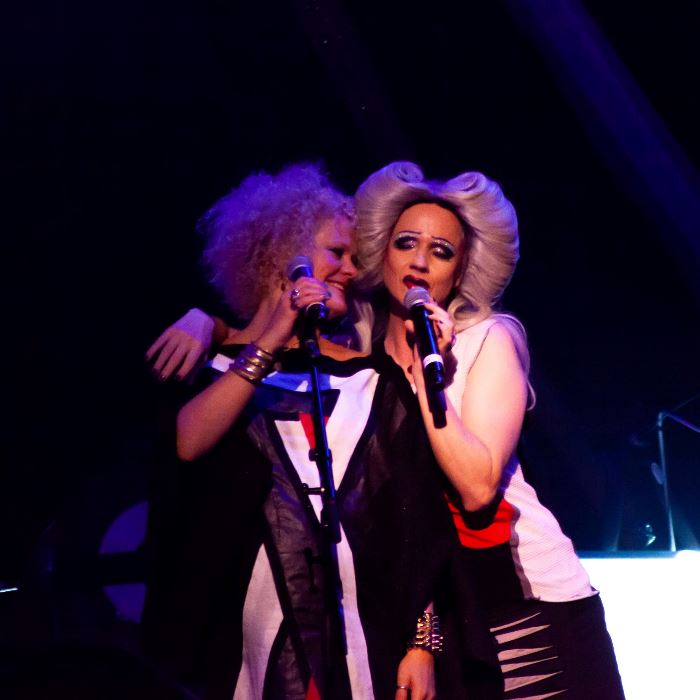
John Cameron Mitchell. Photo by Miguel Villalobos.
Following a pandemic-time postponement of its previously scheduled June run at The Town Hall, the current two-night presentation of John Cameron Mitchell & Stephen Trask: Return to the Origin of Love was, according to Mitchell, just “one positive COVID test away from being canceled.” But despite the spike in Omicron infections across NYC, the show went on to the delight of the enthusiastic fans and grateful performers, who were clearly ecstatic to be back on stage and rocking the house (even though, in accordance with safety protocol, Mitchell’s signature crowd surfing wasn’t an option last night).
The concert traces the evolution of Hedwig, the development of its characters, and the backstories of the artists and their unending support of the queer community through personal recollections interspersed with a set list of the hit’s iconic songs. Although the venue is large, the night is intimate, thanks to the stars’ high-spirited direct-address format, constant interactions with the audience, and open and engaging personalities. From their first meeting and the genesis of their collaboration through the journey of their creative process, the classics and historic events that informed it (including Aristophanes’ speech on “The Origin of Love” in Plato’s 4th-century BC Symposium, the Bible’s expurgated Gnostic Gospels, and the fall of the Berlin Wall in 1989), and the people who contributed to their success (with special shoutouts to the generosity of Lou Reed and Dolly Parton), the show is filled with insights, laughs, and powerhouse performances that defy “the binarchy” and promote non-binary culture.
Amber Martin and John Cameron Mitchell. Photo by Miguel Villalobos.
Along with Mitchell’s outrageous in-character punk moves and blockbuster vocals, and the comparatively softer style and more mellow commentary by Trask (who fronted the ‘90s NYC punk band Cheater), co-star Amber Martin (named one of the Top Performers of the Year by The New Yorker) and special guest Richard Butler (co-founder and lead singer of the Psychedelic Furs) also wowed with their stellar voices, all backed by the Tits of Clay band, under the musical direction of Justin Craig. Among the highlights for theater-lovers and Hed-heads were such favorites from Hedwig as Mitchell’s emotive rendition of the titular “The Origin of Love” and “Wicked Little Town,” here performed as a duet by Mitchell and Butler.
This exhilarating “love letter to Hedwig fans everywhere” is enhanced by hilarious live-feed projections and video by Michael Zumbrun and Cho Su-hyun, wild costumes by Erik Bergrin (most notably Mitchell’s multi-layered “transformer dress”), and the distinctive wig and makeup design by Mike Potter (who has been with the Hedwig team since the beginning at Off-Broadway’s Jane Street Theatre).
The crowd’s frenzied standing ovation resulted in not one, but three encores, each of which consisted of not just a single number, but another full set, featuring additional songs from Hedwig (“Angry Inch” among them), from the performers’ own albums, others by Trask, and hits by such noted rock stars as David Bowie (belted out by the amazing Martin). Mitchell also conducted a live auction of an original artwork, which raised $1000 for charity.
John Cameron Mitchell. Photo by Miguel Villalobos.
You have one more chance to catch this high-energy tribute to Hedwig and its salient alt themes at The Town Hall, so my best advice is to get your tickets now. If you can’t make it tonight, you can look forward to the return of Mitchell and Trask in June 2022. We can only hope that by then he might even be able to return to crowd surfing.
Running Time: Approximately two hours and 35 minutes, without intermission.
John Cameron Mitchell & Stephen Trask: Return to the Origin of Love plays through Thursday, December 30, 2021, 8 pm, at The Town Hall, 123 West 43rd Street, NYC. For tickets (priced from $50-500), call (212) 997-6661, or go online. All proceeds from the sale of VIP tickets, which come with a gift bag of unique autographed items, will go to organizations working across the LGBTQIA community. Based on current CDC and state guidelines, protocols include mask enforcement, proof of COVID-19 vaccination or negative test verification, and photo ID. Ticket holders who do not comply with venue policies will not be admitted.
The Colonial Players, Inc. of Annapolis, Maryland, announces its upcoming winter production of Ronald Gabriel Paolillo’s The Lost Boy, directed by Joe Thompson.
The Lost Boy is a heartwarming, fictionalized story that follows author James Barrie and the forces that drove the creation of his many beloved characters, including Peter Pan. Haunted by the tragic loss of his older brother, James slowly begins to confront his family’s tragic past through storytelling, an unexpected friendship, and the dream of finding Neverland.
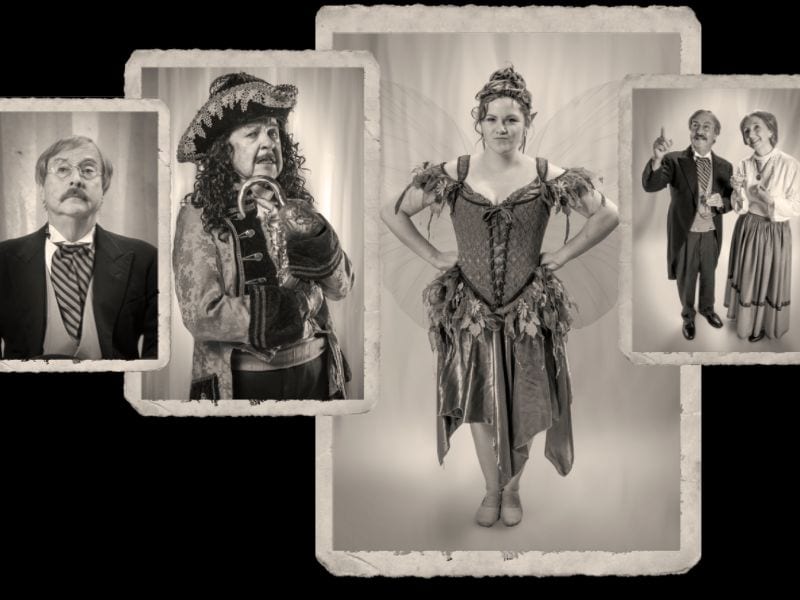
Rick Estberg, Edd Miller, Megan Henderson, Rick Estberg, and Lesley Miller appearing in ’The Lost Boy.’ Photos by Brandon Bentley.
The Lost Boy performs January 14 to February 5, 2022, Thursdays through Sundays, at The Colonial Players’ historic theater-in-the-round in the heart of downtown Annapolis. Tickets ($23 for adults, $18 for 65 and older, full-time students with ID, and active military with ID) can be purchased online or by calling the Box Office at (410) 268-7373 and selecting option 2.
COVID Safety: The Colonial Players require masks to be properly worn by everyone in all of facilities at all times, regardless of vaccination status. The Colonial Players has instituted a variety of enhanced sanitation procedures, including upgraded HVAC systems and frequent sanitization of high-touch surfaces and other areas. Hand-sanitizing stations are located throughout the lobby area.
If you feel sick, or have been in close contact with someone who has tested positive for COVID-19 in the past 10 days, please stay home. See the Box Office page for more information regarding ticket exchanges and refunds.
About The Colonial Players: Entertaining, educating, and enriching the community since 1949. The Colonial Players is a welcoming venue to all members of our community. Set in the heart of historic Annapolis, our theater-in-the-round is a must-see destination for all theater lovers.
Any way you look at it, 2021 was a terrible, awful, no good, really bad year for theater. COVID. Delta. Omicron. Can we just get a break already? The performing arts sector was completely blindsided by a pandemic that kept venues shuttered and people out of work for 18 straight months. And the year is closing with yet another set of disruptions as shows are forced to cancel performances due to breakthrough cases of omicron. But in a testament to the resilience of the industry, theaters and theater-makers wasted no time in getting back to work as soon as it was safe to do so. Throughout the fall of 2021, the DC region has produced an impressive amount of live work. Actors joyfully returned to auditions, designers brushed off their thinking pads, investors provided necessary resources, and audiences gratefully donned masks and teared up when the curtains finally rose once again. The future is still uncertain for the theater industry, but one thing is clear from the impressive quality and quantity of work that has been staged in just the last few months: theater will survive COVID.
Here are the shows that wowed our writers as theaters opened up again this fall. Thank you for your work, DC theater-makers. Life just wasn’t the same without you.
Jaysen Wright, Lauren Davis, Kanysha Williams, Randy Preston, and Vaughn Midder in ‘Acoustic Rooster’s Barnyard Boogie: Starring Indigo Blume.’ Photo by Jati Lindsay.
Acoustic Rooster’s Barnyard Boogie: Starring Indigo Blume, The Kennedy Center
The production is truly an amazing experience, filled with energy, courage, and hope. The songs in the show are a fantastic mix of jazz, soul, hip hop, blues, and everything in between, featuring each of the cast members in varying genres. I would almost say that the adults enjoyed the show even more than the kids did, with the references to lyrics and characters’ human counterparts most likely lost on the youth but hilariously clever for the benefit of the grown-ups. Read Kendall Mostafavi’s full review
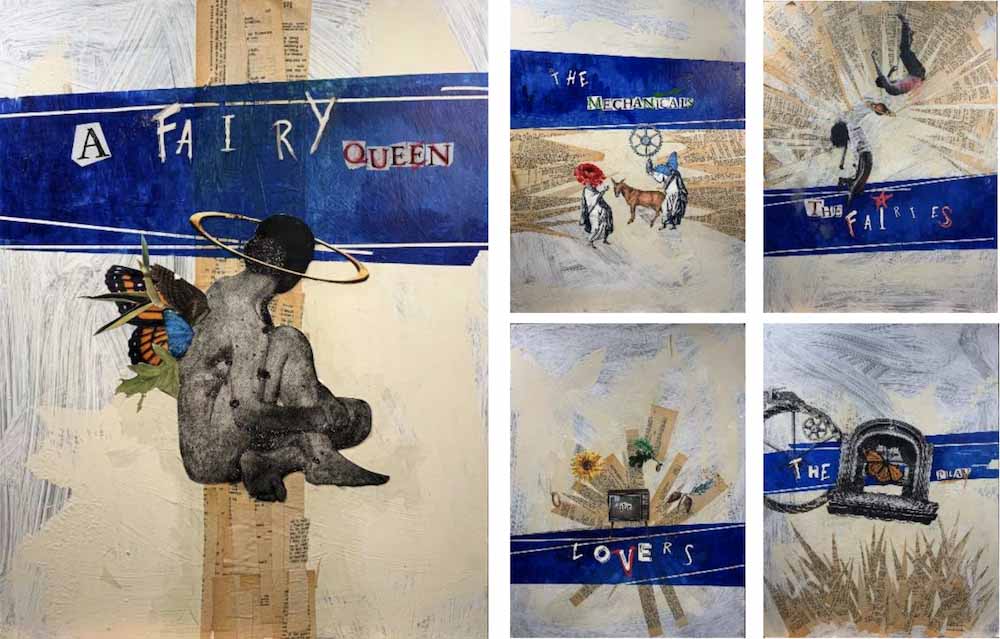
Poster art by Kel Millionie
A Fairy Queen, The IN Series A Fairy Queen — centered on music by Henry Purcell and Shakespeare’s A Midsummer Night’s Dream — has been reworked to evoke the experience of attending a live recording session of an old-time radio program, complete with live sound effects. Placing this story in a radio studio goes right along with 17th-century versions of the practices of sampling, remixing, and mashup. And in Timothy Nelson’s knowledgeable hands it comes off not like a gimmick but as a doorway into the discovery of connections between human emotion and experience in the two different eras. Who knew that lust and naughtiness in 17th-century Europe were not merely academic? Hearing Alleluias sung by Lucy Page with unmistakable orgasmic intent made me wonder “How long has this been going on?” and how much have I been missing when I encounter these older works? Read Gregory Ford’s full review
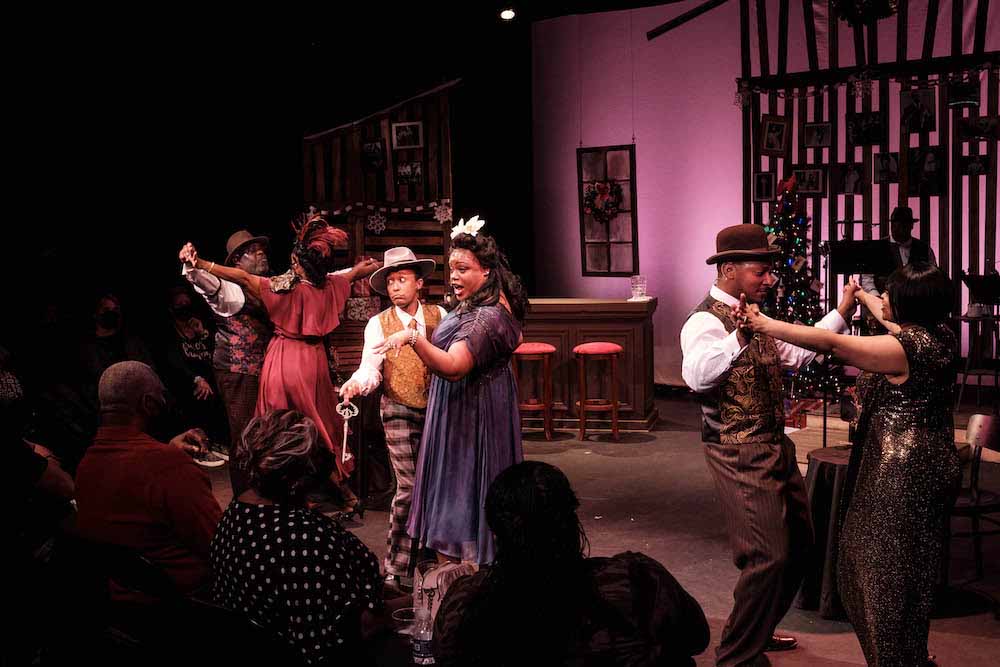
The Dew Drop Inn performers get the crowd riled up with ‘You Got the Right Key, But the Wrong Keyhole’ in ‘A Snowy Nite at the Dew Drop Inn.’ Photo by Bill Lee.
A Snowy Nite at the Dew Drop Inn, Anacostia Playhouse A Snowy Nite at the Dew Drop Inn sparks joy. This new show at The Anacostia Playhouse is all about having a good time in a world full of dark, cold nights. And unless you are the embodiment of Ebenezer Scrooge, a good time is exactly what you will have. There is singing, dancing, and broad, silly, and obvious jokes on the naughty side of things. And these people dance and sing (and clown around) as if their very lives depend upon it. Read Gregory Ford’s full review
A Strange Loop, Woolly Mammoth Theatre Company
Stopping off at Woolly Mammoth on its way to Broadway — following an off-Broadway run that won it the Pulitzer Prize for Drama — Michael R. Jackson’s extravagantly original musical, A Strange Loop, is in a class of smash hits by itself. I’ve been trying to think of anything else that comes close to resembling it, and I can’t. In thematic dimensionality and depth, raw candor, and knockout meta-theatricality, A Strange Loop is beyond compare. And the lead, played by the phenomenally talented and charismatic Jaquel Spivey, becomes easily one of the most adorably complex characters who might ever win you over onstage. Read John Stoltenberg’s full review
Beauty and the Beast, Olney Theatre Center
Innovative casting, direction, and design combine to make Olney’s Beauty and the Beast a story about two outsiders finding love and creating a home with each other, no matter how much the odds are stacked against them. As Belle and the Beast, Jade Jones and Evan Ruggiero aren’t just groundbreaking in their roles but are top-notch actors whose stellar performances universalize the experiences of the bodies they inhabit. Read Darby Dejarnette’s full review Read Nicole Hertviks’ Q&A with Director Marcia Milgrom Dodge
Boheme in the Heights, The IN Series The characters in Boheme in the Heights are Afro-Latinx. The story has been relocated to the Columbia Heights neighborhood of DC and presented as a silent film that includes live-action images of the actor-singers embedded in animation that fluidly portrays the feelings and thoughts that permeate and affect the everyday reality around the characters. The singing that is meant to come from the characters on the screen is performed live with keyboard accompaniment. This live performance brought the breath and urgency that the on-screen characters were experiencing out into the same room that we occupied as audience members. We experienced these human sounds — of suffering, ecstasy, joy, and hope — without the intermediaries of vinyl and needle or cellulose acetate and light. At the same time, the images moved in confluence with the changes in the music. (The digital production of Boheme in the Heights streams for free here,) Read Gregory Ford’s full review
Hadestown, The Kennedy Center Hadestown at the Kennedy Center brought us the best of Broadway. It won a total of eight Tonys in 2019, including Best New Musical. The soaring music, explosively lovely design, and first-rate performances welcomed us back to the world of live theater.
This story of all-too-human gods and star-crossed lovers was lusciously musical. Read Jordan Wright’s full review Read Sophia Howes’ column
Hedwig and the Angry Inch, Olney Theatre Center Hedwig is full of stunning vocals and powerhouse performances. The amount of energy needed for one evening as Hedwig seems monumental, and Mason Alexander Park gives it their all. The resultant performance is masterful and guaranteed to stay with you for a long time after. Read Julia Amis’ full review
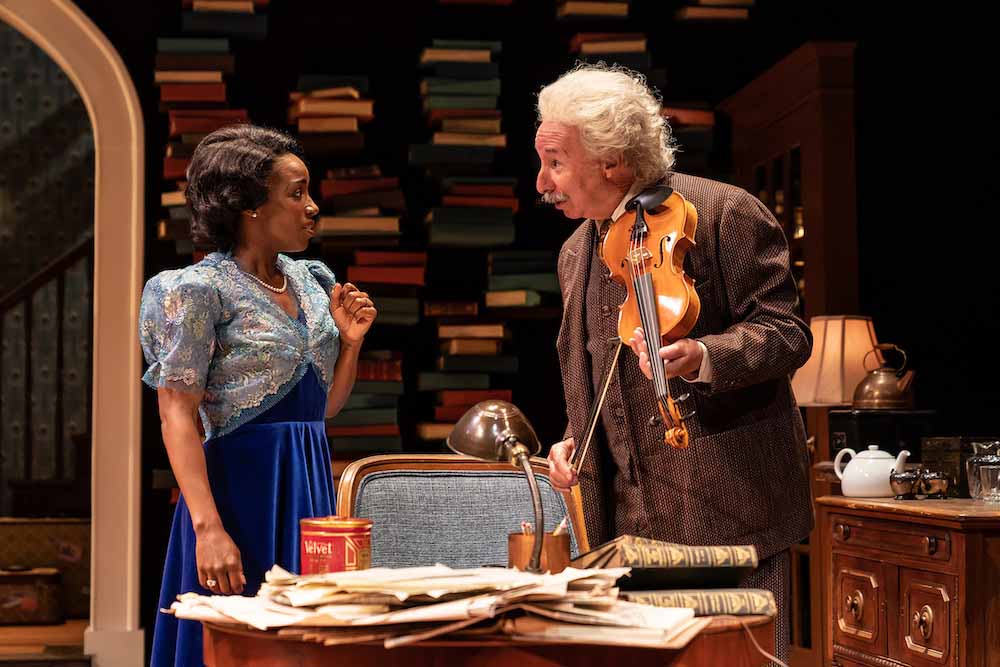
Felicia Curry as Marian Anderson and Christopher Bloch as Albert Einstein in ‘My Lord, What a Night.’ Photo by Scott Suchman.
My Lord, What a Night, Ford’s Theatre My Lord, What a Night saves the best for the very last. Sitting in the Ford’s Theatre, an auditorium perfectly suited in time and place, gazing up at the box where Abraham Lincoln was assassinated, as a curtained graphic projection with the looming image of the Lincoln Memorial descends, is almost emotionally overwhelming. Felicia Curry as Marian Anderson steps forward in that famous full-length mink coat and with the fervor and the dignity of a living legend sings the first stanza of “My Country ‘Tis of Thee.” This is the very moment when My Lord, What a Night becomes a truly thrilling production. Read Ramona Harper’s full review Read Ravelle Brickman’s interview with Felicia Curry
Lauren Zakrin as Little Mermaid, Selene Haro as Gretel, Ashley Chiu as Sleeping Beauty, Adrianna Weir as Little Girl, Wonu Ogunfowora as Rapunzel, Aisha Jackson as Snow White, Jennifer Florentino as Little Red Riding Hood, and Amy Hillner Larsen as Goldilocks in ‘Once Upon a One More Time.’ Photo by Matthew Murphy.
Once Upon a One More Time, Shakespeare Theatre Company Once Upon a One More Time — with its improbable storyline featuring Britney Spears, Betty Friedan, and fairy tale princesses — is as thought-provoking as it is toe-tapping, as clever as it is hilarious, as bold as it is shiny. It sounds like the world’s wackiest idea for a musical until you’ve seen it, but by golly, it works. Once Upon a One More Time is a full-fledged, grade A, gold star success and exactly the party we need after 21 months of COVID. Read Nicole Hertvik’s full review
The plot is nearly as outlandish as the fairy tales it critiques, and it’s delivered with sensational musical theater performances and stunning stagecraft to the tune of music made mega-famous by Britney Spears. The show’s pop feminist messaging is a far cry from the passivity and victimization promoted to girls for eons in classical fairy tales (“Well-behaved princesses rarely make history,” as Cinderella reminds Snow White). But not coincidentally this specific message of female self-reliance and empowerment is also the most foundational raison d’être for mounting this production at the estimable Shakespeare Theatre Company. Princesshood is powerful. Who knew that could come true? Read John Stoltenberg’s column
Remember This: The Lesson of Jan Karski, Shakespeare Theatre Company I have long contended that all theater in Washington is political. (It’s in the oxygen we breathe.) Few works, however, pack the wallop of Remember This: The Lesson of Jan Karski. The play reminds us of inconvenient truths, challenges us, and offers us the opportunity to transform ourselves through the experience of theater. This is due in great part to the stellar, incredibly moving performance of David Strathairn. Read Susan Galbraith’s full review
Historian Timothy Snyder states: “We would all like to imagine that we would have tried to stop the Holocaust. We would have crept into the ghettos to learn the truth, found our way into the Allied capitals, and made the case for action.” But, as Snyder rightly observes, only one of the approximately two billion adults on the planet did: the Polish courier, Jan Karski.
Many now believe that there is once again a threat of fascism, not only across the world but right here in the United States. Today, the lesson of Jan Karski has become more crucial than ever. Read Sophia Howes’ column
Rent, Signature Theatre Signature Theatre has reopened its doors post-pandemic shutdown with the rock musical Rent, Jonathan Larson’s creation loosely based on La Bohème’s characters and story. It’s a ripping good choice. The sound and sheer energy of the work and these singer-dancers raise our pulse and welcome us back to the American musical. Artistic Director Matthew Gardiner has directed Rent as if we’re in the midst of and sharing in the characters’ challenges with the story happening all around us. The take on the production, more than 25 years after it first opened, proves once again that groups of young people may suffer greatly and will face enormous odds at being included in society’s plan; they will be blamed and shunned for society’s ills but will find community with one another and ultimately choose love. In these still difficult times, Rent is a much-needed tonic for the soul. Read Susan Galbraith’s full review
Alina Collins Maldonado (Delia) and Luis Alberto González (Abel) in ‘Secret Things.’ Photo by Teresa Castracane.
Secret Things, 1st Stage Secret Things by Elaine Romero at 1st Stage presents two themes—the search for spiritual identity and the quest for a life partner—with creativity and grace. It is well-acted, beautifully produced, and features a love story that will send you out of the theater with a renewed sense of life’s possibilities. Read Sophia Howes’ full review
The cast of ‘The Amen Corner’ at Shakespeare Theatre Company. Photo by Scott Suchman.
The Amen Corner, Shakespeare Theatre Company With the brilliant directorial conception of Whitney White, The Amen Corner pays homage to the Black Church in the rhythm, music, and movement of this emotionally moving play-with-music. And oh, how glorious is the music. Under Music Director Victor Simonson, the affirmation of song completes each dramatic crescendo. Just like a Greek chorus that exchanges tragedy for jubilation, the choir’s powerfully pleasing voices could resurrect Dionysius. The soul-stirring singing adds clout to a joyous shout, while the piano man takes the jazz out of the club and blasts it at the altar. Get-happy praise dance adds frenetic energy to gospel music that’s divinely right on time, and there are enough hallelujahs to lift the soul as well as the rafters of the Shakespeare Theatre Company’s Sidney Harman Hall. Read Ramona Harper’s review of the 2020 production that closed due to COVID Read John Stoltenberg’s interview with Director Whitney White
Though the first scene jumps out at you in a big ensemble number with foot-stomping, hands-clapping, and Black Church testifying, make no mistake: playwright James Baldwin had a much deeper and darker intent in writing The Amen Corner. Just as the writer eloquently and with righteous anger confronted racism and white bigotry in so much of his life’s work, so in this early drama (1953) he turned his seething gaze inward on what he witnessed in his own community and leveled an indictment on the church, with all its backbiting, backstabbing politics and especially hypocrisy. Director Whitney White seizes upon Baldwin’s intent and keeps the thrust of the story moving. The Amen Corner production has been seasoned well by this ensemble as it opened originally back in 2020 but then shut down soon after due to COVID. New to the show this round is Roz White in the role of Odessa, who gives one of the most nuanced and truthful performances of the evening. Read Susan Galbraith’s full review of the production that reopened in 2021
Pauline Lamb as Claudia and Jordan Brown as Curtis in ‘Time Is On Our Side.’ Photo by DJ Corey Photography.
Time Is On Our Side, Perisphere Theater As we grapple with the reality of historical events, the impact of social media, trust, and friendship, Time Is On Our Side covers all these issues in a hilarious spin. Baltimore native R. Eric Thomas is truly laugh-out-loud funny as reflected in his massive following as host of the Moth in Philadelphia and for his essays about everyday life. He indicated that the script is inspired by “real histories and lives in one American City but reflects the journeys of so many people across the country and through time.” So true. After a year of staying indoors, this was one of the first productions that got me back in the theater and it was a raucously fun re-entry. Read Debbie Minter Jackson’s full review
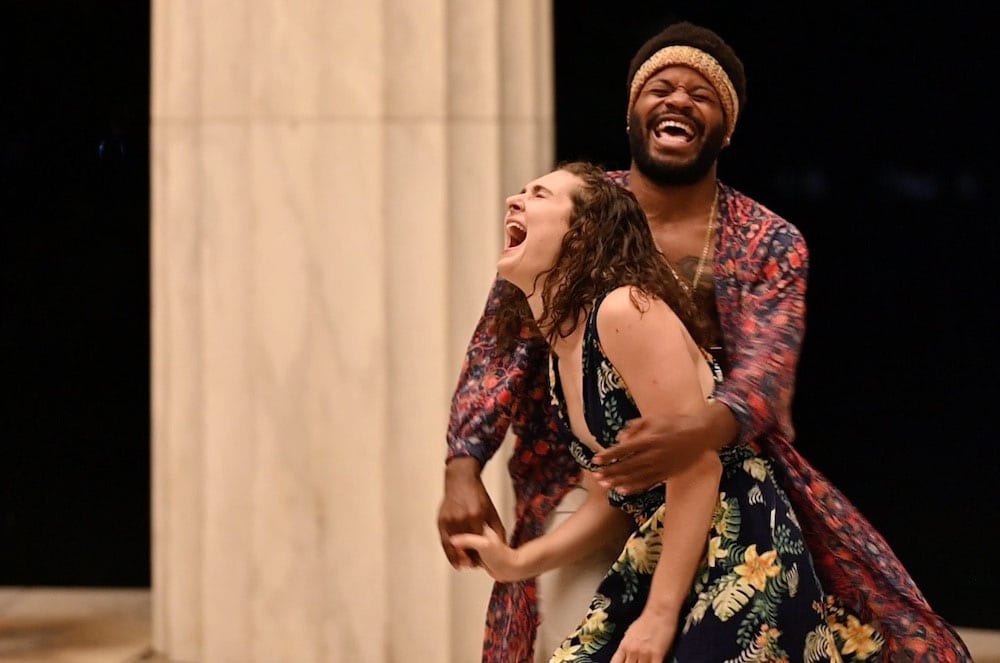
Anna DiGiovanni (Viola) and Terrence Fleming (Orsino) in ‘Twelfth Night.’ Photo by Kathleen Akerley.
Twelfth Night by Her Majesty & Sons at the DC War Memorial
A merry band of DC theater artists has brought us a glorious present. Their new company, Her Majesty & Sons, is performing a 90-minute adaptation of Twelfth Night, or What You Will, one of Shakespeare’s most popular comedies, with live music, under the dome of the DC War Memorial on the National Mall. It is a true love fest, full of hijinks, mistaken identities, and, best of all, midsummer madness. Read Sophia Howes’ full review
The stage and audience on Black Lives Matter Plaza for ‘Working, a Musical.’ Photo courtesy of Working in DC.
Working, A Musical, Working in DC at Black Lives Matter Plaza Based on actual oral histories, Working, A Musical is a swiftly paced flow of catchy and touching songs interspersed with scenes that function as sharply drawn character sketches. The ensemble’s opening number, “All the Livelong Day,” sets the Whitmanesque tone: “I hear America singing.” And hear America we do, as the versatile cast of nine actor-singers portrays some two dozen jobholders — from trucker to tech support, from grocery checker to ironworker, from community organizer to stonemason. As one character says during the show: “History is a hell of a lot of little people getting together and deciding they want a better life.” The entire entertaining evening was a vivid dramatization of that point. See John Stoltenberg’s full review
In response to the surging, highly transmissible omicron coronavirus variant, Washington Improv Theater has announced more stringent vaccine and masking requirements to ensure the highest level of public safety for its students, audiences, artists, staff, and volunteers. Proof of a COVID-19 booster shot will be mandatory for entry to Source Theatre where WIT performs, and medical-grade masks (not cloth masks) will be required.
In August 2021, an ad hoc coalition of DC-area theaters began requiring patrons to show proof that they are fully vaccinated against COVID-19 and to wear masks inside the theater, except while eating or drinking in designated locations. (See “DMV theaters unite to require proof of COVID vaccination.“) Those requirements were recently extended through March 2022.
WIT is the first local performing company to tighten its COVID-19 safety protocols to specify booster shots and quality of mask.
Explained WIT Operations Manager Jordana Mishory, the staff member who got the conversation started about increasing WIT’s protocols: “The safety of our community remains our number one priority. And as we have been tracking the developing news around the omicron variant, it became clear that the measures we had in place, while appropriate for delta, were not rigorous enough for the new variant. Because scientists and health officials stressed the importance of booster shots and medical-grade masks, we felt obliged to step up protocols for our community.”
Artistic/Executive Director Mark Chalfant adds, “Our new protocols are calibrated for our programming, primarily small 12-person classes and an audience of 75 people in a small black box theater. The situation is extremely fluid and could change any day, so we will remain aware and responsive. When reflecting on our organizational values, heightening our COVID protocols was the right thing to do for our performers and teachers, and for the people who want to see our shows and take our classes.”
Additionally, WIT is encouraging its performers to take a rapid at-home test before stepping on stage maskless.
Mandating Booster Shots
WIT will now require all students, performers, faculty, volunteers, staff, and audience members to receive a COVID-19 vaccination booster shot by Sunday, January 30, 2022 — or 30 days after becoming eligible for a booster, whichever is later. (According to the CDC, all adults are eligible for a booster shot six months after their second shot of Moderna or Pfizer and two months after their first shot of Johnson & Johnson.) Performers and audience members will need to show their vaccine proof at the door.
Requiring Better Masks
Medical experts report that cloth masks do not provide enough protection in the face of omicron, so WIT will be requiring medical-grade (or better) masks while in attendance at shows, classes, workshops, jams, and other inside events. While recommending well-fitting KN95 or N95 masks, WIT will be requiring at least a medical-grade mask to enter the premises. Masks must be worn over the mouth and nose while inside the building. Cloth masks will be prohibited unless being used to double-mask. And concessions will remain closed at all performances to ensure masks remain on.
About Washington Improv Theater
Washington Improv Theater is dedicated to unleashing the creative, collaborative power of improv in DC. WIT is DC’s premiere arts organization showcasing and advancing the art form of improvisational theatre with over 200 artists, 30 instructors, 1,000 students, and 14,000 audience members engaging annually in performances and classes. WIT is a multi-tiered arts organization: a producing organization exploring and forwarding the craft of long-form improv in challenging new directions; a presenting organization allowing improvisers from across the country to share their artistry with DC audiences; a community organization serving a rapidly growing family of improv artists. WIT is the place for improv in DC.
More information about WIT’s COVID safety protocols is here.
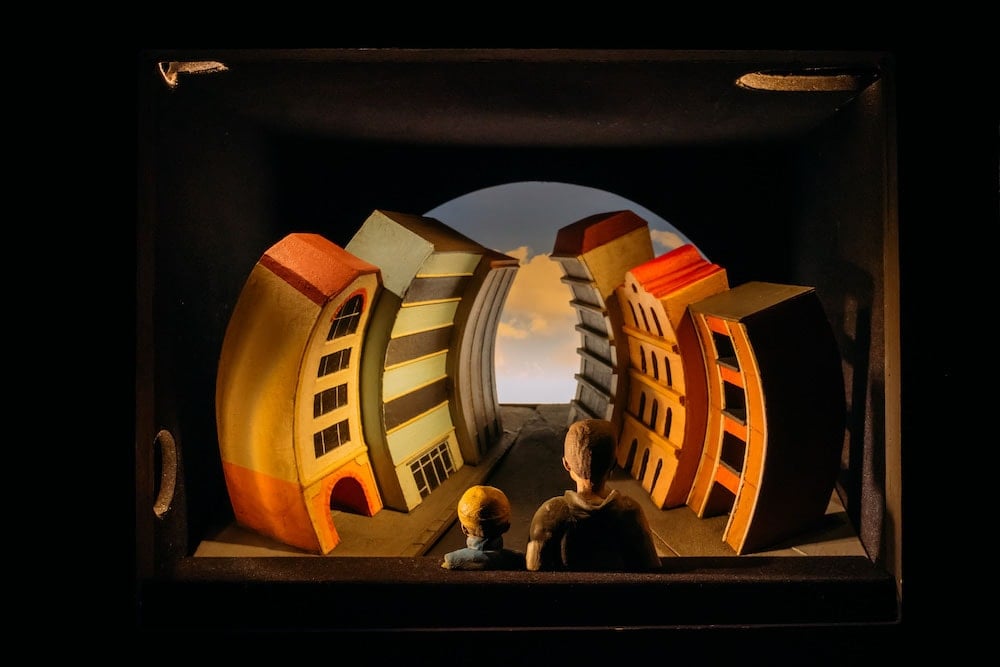
Two orphaned brothers, Aryan and Kabir, leave their home in Afghanistan to search for safety in England. They have a small inheritance sewn into their clothes, and they have each other. Like their lives, their memory of their own culture has been atomized, blown into darkness. They face violence, police raids, economic exploitation, and brutal personal circumstances to achieve their dream.
Flight at Studio Theatre offers the opportunity to learn their fate. It is truly a tour de force — a welcome destination for those who seek out art in these uncertain times.
Athens scene from ‘Flight.’ Photo by Mihaila Bodlovic.
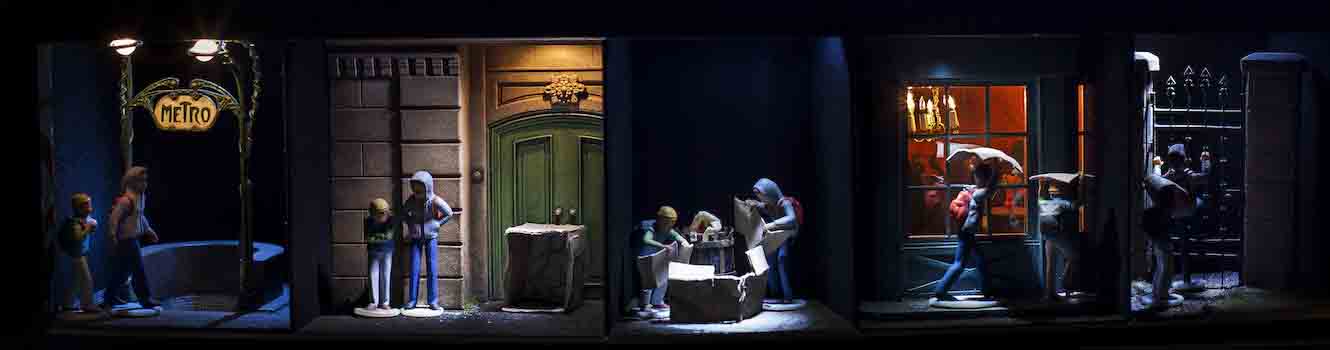
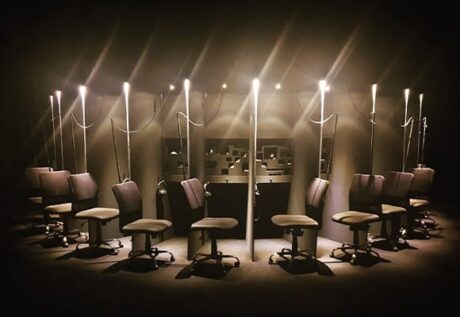
There are no live actors.Each audience member has a personal viewing booth with headphones. Performances are capped at 25 patrons. The story is told in 230 highly detailed, moving dioramas. This immersive experience, in an intimate setting, is based upon the novel Hinterland by former Reuters and New York Times International journalist Caroline Brothers. Although the events are fictional, they are based on Brothers’ interviews and encounters with young refugees across Europe.
Originally commissioned by the Edinburgh International Festival, Flight has toured internationally and was named one of the most Unforgettable Theatre Moments by the New York Times in 2018. Flight is a kind of hybrid — a theatre piece as well as an installation. It was created by Scottish theater company Vox Motus, adapted by Oliver Emanuel, and directed by Candice Edmunds and Jamie Harrison.
“Am I an Afghan?” Kabir asks his brother. He can barely remember his native country. Aryan, 14, is determined to save his brother at all costs and is saddened when he realizes that Kabir, 8, is no longer a little boy.
They are still, however children. Kabir would like a dog and wants to be a world-famous singer and guitarist. Also a chef. Aryan has a deep love for maths, finding the figures appealingly pure and, as Caroline Brothers notes, impervious to loss.
Paris sequence from ‘Flight.’ Photo by Drew Farrell.
They have a mantra that keeps them going, composed of the names of cities: “Kabul, Tehran, Istanbul, Athens, Rome, Paris, London.” Another inspiration is Bruce Willis, an icon of American action movies.
Flight asks the same question as Ivan Karamazov in The Brothers Karamazov: Can we live in a world that countenances the suffering of children? We can. We do.
Oliver Emanuel’s adaptation is interspersed with the poetry of Rumi. It is full of images of birds: pigeons, turtledoves, even a canary. In the diorama, the police appear, amusingly, as seagulls. The sound score is exceptional, full of music, the sea, rifle shots, drums, cars.
In 2017, the United Nations Children’s Fund counted 300,000 unaccompanied and separated children moving worldwide. And these are only the documented cases.
Aryan carries: a plastic wallet, a red mobile phone without SIM, and a tiny book of Afghan poetry. Kabir has nothing in his pockets except dreams.
Don’t miss their remarkable journey.
Running Time: 45 minutes, with no intermission
Flight plays through March 6, 2022, at Studio Theatre’s Stage 4, 1501 14th St NW, Washington, DC. Performances are Tuesday – Friday at 6 pm, 7:15 pm, and 8:30 pm; Saturday and Sunday at noon, 1:15 pm, 2:30 pm, 3:45 pm, 5 pm, 6:15 pm, 7:30 pm, and 8:45 pm. There will be no performances on December 24 and 25, or on January 1. Tickets start at $42, with low-cost options and discounts available, and can be purchased online or by calling (202) 332-3300.
Audience seating for ‘Flight.’
COVID Safety: Proof of vaccination (or a negative COVID test) and facemask are required. Studio Theatre’s complete Health and Safety protocols are here.
Flight does not feature live actors. This immersive production is experienced by audience members from their own personal viewing booths and with headphones. Performances are capped at 25 patrons. Cleanings will be conducted between performances.
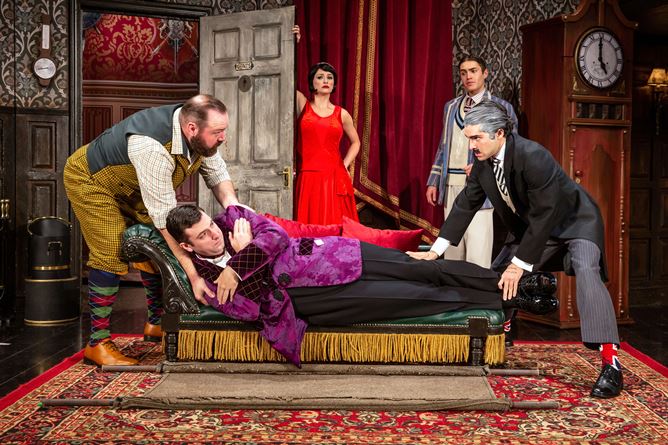
Since moving to the US, British-born and NYC-based Chris Lanceley from Liverpool, who has appeared on network television (FBI; Blue Bloods) and Off-Broadway, is either “a terrible actor” or “the greatest actor to grace New York City,” depending on which tongue-in-cheek quote you believe from his website. For those of us who’ve seen him in the smash hit comedy The Play That Goes Wrong at New World Stages (many of us multiple times), we know he’s a terrific actor who has the difficult task of playing a bad actor in the role of a dead character, and he does it with sidesplitting aplomb.
Brent Bateman, Chris Lanceley, Bartley Booz (front), Maggie Weston, and Jesse Aaronson (behind). Photo by Jeremy Daniel.
An alumnus of the National Youth Theatre of Great Britain, Lanceley graduated from the American Academy of Dramatic Arts in 2010, before joining the Academy Company in 2011. And he’d also like everyone to know that his accent isn’t an issue, so feel free to hire him here and let him keep racking up those well-deserved fifteen minutes of fame, which he’s already exceeded.
Chris took some time during this busy season to answer my questions about the show, his career, and what he enjoys most about the holidays.
Chris Lanceley. Photo courtesy of the artist.
Has anything ever really gone wrong for you while on stage?
Chris: Once in a community theater production I did growing up, the set had a door on it that led to the outside of the theater. None of the actors used the door and it was only part of the set because there wasn’t enough space. On opening night an audience member was running late and rushed through the door thinking it was the entrance to the theater. For some reason they stood there quietly on stage and watched the scene until the house manager checked their ticket and seated them.
What’s the biggest challenge of playing dead?
Itches. I can’t scratch my nose. Excruciating!
What’s the best thing about being back in front of a live audience?
People with funny laughs! There’s always one person with an unusual laugh that makes the rest of the audience feel more comfortable laughing at the show! These people are the real heroes.
Chris Lanceley and the cast. Photo by Jeremy Daniel.
Which came first for you – drama or comedy?
For me, good comedy comes from drama. The Play That Goes Wrong isn’t a comedy to the characters, it’s a tragedy! Their beloved production is falling to pieces around them and so much of the humor comes from how seriously they’re taking each of the ridiculous things that happen to them.
What’s your first creative memory?
When I was growing up, I used to draw cartoons based on a popular British comic book called The Beano. I had my own characters, but they’d always go on adventures with the characters from The Beano! I think I even sent my drawings in to them once or twice.
What three emotions do you feel when you’re performing?
Pride, excitement, and joy. I’m proud of our show and the fact that I get to walk on this stage with these people every night. It will never not excite because this show is never the same twice!
Chris Lanceley. Photo courtesy of the artist.
What three words would you use to describe yourself?
Thoughtful, passionate, and caring. It’s really hard to find an answer to this question without it sounding like a humble brag!
What’s the most fabulous thing about the holidays?
Family and home. Recently I haven’t been able to head home to the UK to be with my family at the holidays, but we always make the effort to connect and spend time together even if it’s virtually. The holidays are a time when I always make sure I have some home here in NYC, British food, television, music. A bit of nostalgia!
What’s at the top of your Christmas list this year?
A win from Liverpool FC, a couple of video games, and great show on Christmas Night!
Chris Lanceley. Photo courtesy of the artist.
Do you have a New Year’s resolution for 2022?
I’m rubbish at work/life balance! Theater is so consuming, especially when you’re so in love with the show and what you’re doing all week. It’s even more consuming because as well as playing Jonathan I also understudy the role of Chris. I want to get better at planning meals and taking care of myself and making use of my down time.
Do you think you’ll actually keep it, or is it likely to go wrong?
No, it’ll go wrong. January 1st I’ll buy my lunch at a deli, not drink enough water, and spend all day scrolling on my phone.
What’s your favorite holiday treat?
Minced pies. You Americans are missing a trick with those, seriously. I also love roast potatoes; I know I can have them any time of year, but they’re best when they’re surrounded by Christmas dinner.
What do you miss most about England?
Outside of my family, going to the football – soccer, fine – and watching Liverpool FC. I’m a big football fan and watching my team play live is like nothing else.
Chris Lanceley (upper right) and the cast. Photo by Jeremy Daniel.
What do you love most about NYC?
The opportunity. I feel like if I work hard there will always be new and exciting ways to succeed.
What are you most looking forward to in the coming year?
I’m really looking forward to my sister’s wedding in May! It’s been postponed a couple of times already due to the pandemic, so it’ll be really exciting to finally go home and enjoy the wedding!
Thanks, Chris, for not going wrong with this interview! Best wishes for Christmas and the New Year, and congrats on your stellar performance in one of the most hilarious shows I’ve ever seen.
The Play That Goes Wrong plays an open-ended run at New World Stages, 340 West 50th Street, NYC. For tickets, call (212) 239-6200, or go online. All audience members must present proof of being fully vaccinated, along with a photo ID, before entering the building, and must wear masks when inside.
Adventure Theatre MTC is celebrating its 70th season and to commemorate this milestone has produced Winterfest for the holidays. The production features three multicultural shows, each celebrating the love and joy the season brings: “Uri & Ora Light the Menorah” by Robyn Shrater Seemann, “Connection” by Diego Maramba & Michelle Bowen-Ziecheck, and “Cranky Penguin” by Keegan Patterson. Cara Gabriel — DC-based director, writer, educator, and performer — served as director for the trio.
This is a world premiere for all three shows, commissioned by Adventure Theatre, and in order to get some insight on the thought process and desired effect of the entire production, I reached out to Gabriel with some questions:
Cara Gabriel
Doing three shows in one isn’t very common. Do the stories connect in any way?
Cara Gabriel: The three shows take us on a sort of chronological journey through the holiday season. The first piece takes place during Chanukah, the second piece takes place at Christmas, and the third piece takes place on New Year’s Eve. So it really does carry us through the holiday season, and I think most people will be able to find something in one of the three shows that they can find joy and meaning in.
Was there any special meaning in these new shows in particular?
It is not lost on me that these three shows were born of pandemic times — a time when collectively, as a society, we were all yearning to connect to each other in any way possible. Seeking ways to overcome our collective isolation. The second play in the roster is even called “Connection.” And each of the three plays focuses on the need for connection and the various means to make such connections. Some of the pieces are focusing on connecting with one’s culture, some seek to connect with our ancestral past, some seek to connect with the future, or future generations, some seek a more spiritual type of connection, but mostly they are all focused on the ways in which we struggle to connect with other beings in the here and now, despite a multitude of obstacles — be they literal, metaphorical, or metaphysical.
Emily Gilson, Sophie Schulman, Sally Imbriano, and Linda Bard in ‘Uri and Ora Light the Menorah.’ Photo courtesy of Adventure Theatre.
What was your goal and focus while directing these shows?
I wanted to make sure we focused on the following elements, in order to emphasizethe theme of connection:
• MAGIC AND MIRACLES — Each play has an emphasis on the miraculous, or something magical. I wanted to make sure we found the magic in each of the three shows and conveyed the miraculous to our audiences. That said, what I think we sometimes forget is that magic and miracles begin with us. Begin with our own humanity. So I wanted to make sure that the audience felt a part of that magic, that they were able to help create the magic with the production. There is a sort of paper doll projector element to the show, but rather than making it seem like those projections come from some sort of iCloud in the sky, I wanted to expose the mechanics of that magic for the audience. The audience can actually see the actors manipulating the paper dolls, and then see the magic of the way those dolls are projected onscreen.
Andrew Quilpa and Sally Imbriano in ‘Connection.’ Photo courtesy of Adventure Theatre.
• AUDIENCE PARTICIPATION — While there is a “screen” element to our show with the projections, I wanted to make sure that the shows were first and foremost very human. Our kids have been on screens 24/7 for the past two years,and I wanted to make sure we involved them live and in person whenever we could. I don’t want us to forget about the magic of live theater. So the actors speak directly to the audience, and the audience has an opportunity to interact with the events on stage. I wanted to emphasize the immediacy of theater. The live and living nature of it.
• HUMOR — My goodness, we all need to laugh. We need to breathe. We need to have a shared experience that is something other than trauma and pandemic. So I wanted to create a space for laughter, for the community that comes with laughing together. These shows aren’t all funny, in fact, some of them are downright tear-jerkers at times, but each show has moments of levity and joy. I want us to remember what joy feels like.
On a personal note, do you generally enjoy the holidays?
I do!
So what does this time of year mean to you, and what are your feelings on the importance of creating theater for kids (or anyone, for that matter)?
Linda Bard, Andrew Quilpa, and Sophie Schulman in ‘Cranky Penguin.’ Photo courtesy of Adventure Theatre.
I must say that a theme of connection is a sentiment that many can get behind, now more than ever. The word “connection” means so much more than it used to. And I love the idea that ATMTC has taken, of bringing different cultures and traditions but celebrating them together to show that even though they are different they too are connected.
It’s a beautiful message for everyone but even more so for our youth, who have missed out on so much socialization, which is a necessary step in understanding others who may have different traits, hobbies, belief systems, and the like.
Adventure Theatre’s Winterfest is quite clearly a passion project, made with love and hope for our future generations. Love of diversity and all that defines us in a myriad of ways. And hope that the youth will share that love and heal the many divides that are present across the world today.
A lofty goal indeed, but a goal worth supporting.
Winterfestruns through January 2, 2022, at Adventure Theatre in Glen Echo Park, at 7300 Macarthur Blvd, Glen Echo, MD. Tickets are $20.50 and available online, or by calling the box office at (301) 251-5766. To learn more about ATMTC’s 70th season, click here.
COVID Safety: As Adventure moves to indoor performances and in the spirit of protecting the most vulnerable in their community, Adventure Theatre requires everyone attending its shows to wear a mask regardless of vaccination status. Proof of vaccination or a recent negative COVID-19 test, no more than three days old, will be required for admission for all individuals ages 12 and up. To view ATMTC’s full COVID Protocols, click here.
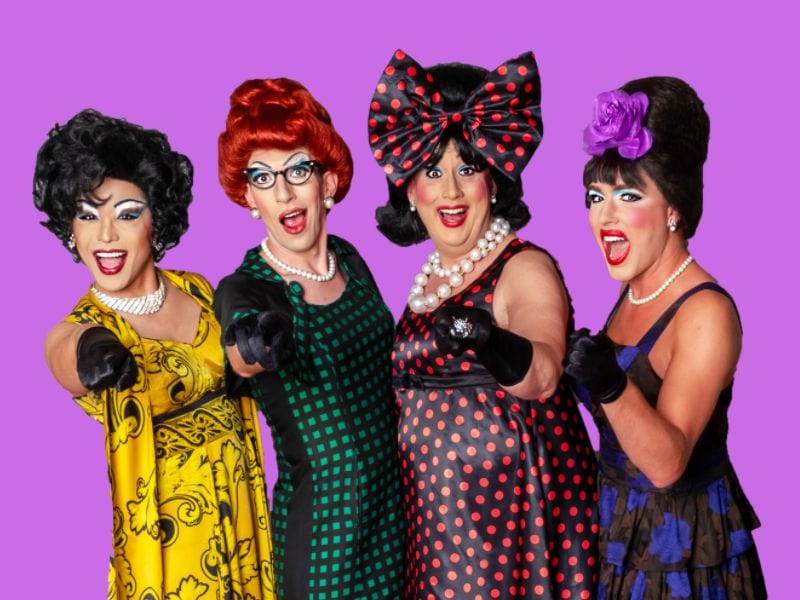
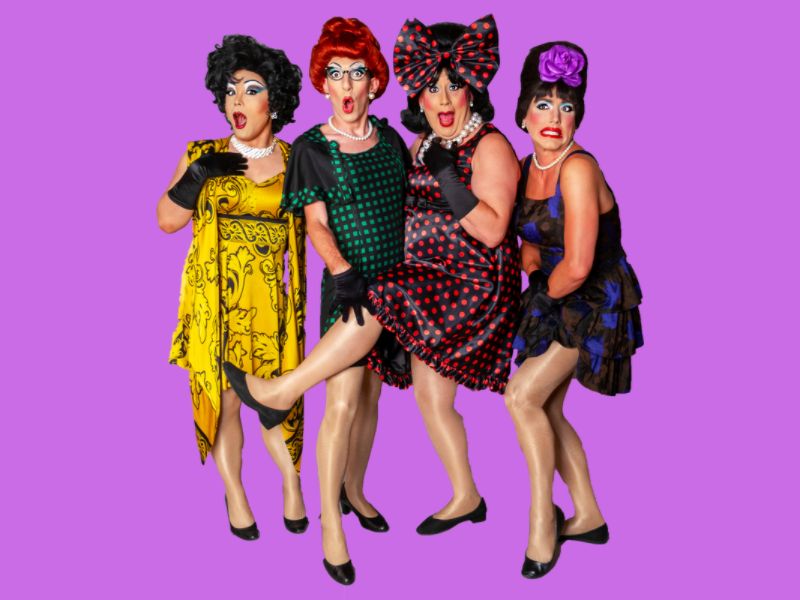
They’re back! After a five-year hiatus, the Kinsey Sicks—possibly the raunchiest quartet in harmonic history—are back on stage at Theater J with Oy Vey in a Manger, a satirical revue performed by a group of gifted singers who are as talented as they are funny.
Like Santa—whose image is plastered all over the set—this visiting troupe will be in and out in a trice, with just five in-person shows remaining before they decamp for the next stop on their tour. (Luckily for the COVID-leery among us, the show will be streaming through New Year’s Eve.)
The Kinsey Sicks: Jeff Manabat as Trixie, Nathan Marken as Winnie, J.B. McLendon as Angel, and Spencer Brown as Trampolina in ‘Oy Vey in a Manger.’ Photo by Paco Ojeda.
Founded 27 years ago by a group of lawyers and politicos who just happened to have a lot of musical training behind them, the group has toured most of the civilized world with their mix of political satire and shtick.
The show opens with a promise to be “hip and funny,” and it lives up to its claim. Jokes fly. There are good ones and bad, some lewd and some crude, mixed with satire and farce.
Some jokes elicited groans from the audience, yet the people around me clearly enjoyed the interaction. (The performance I attended—a weekend matinee—had a full house.)
All in all, Oy Vey is a wonderful mishmash of all kinds of comedy, interlaced with satire and an abundance of smut that was reminiscent of burlesque. Shakespeare would have loved it.
The premise, such as it is, is that the girls—having bought a certain manger (yes, that one) a few millennia ago—are now in danger of being evicted. They’re trying to sell off the place before it’s foreclosed.
But first, they’re happy to sing us some of their holiday classics, including “Lusty the Snowman,” “Soylent Night,” and “I’m Dreaming of a War on Christmas.”
(Jews, they remind us, in a reference to songwriters like Irving Berlin, “don’t sing Christmas carols. They just write them.”)
But—this being an equal-opportunity satire—there are plenty of attacks on Jewish stereotypes, using Hanukah melodies for songs like “I Had a Little Facial” to the tune of “I had a little dreidel.”
The cast is great. All four of the actors possess fine voices and a sense of timing that is spot-on.
The Kinsey Sicks: Jeff Manabat as Trixie, Nathan Marken as Winnie, J.B. McLendon as Angel, and Spencer Brown as Trampolina in ‘Oy Vey in a Manger.’ Photo by Paco Ojeda.
Calling themselves Dragapella (drag queens singing acapella), they are quintessential stand-up comics, masters (or mistresses) of shtick who are capable of belting out beautiful sound on their own, yet rapturous when singing together. They are also fine actors.
Nathan Marken is Winnie, a tall—make that very tall—redhead in glasses. Winnie is the ultimate Jewish mother, constantly reminding the girls to clean up the mess before the visitors arrive. (On the show’s website, Winnie offers her favorite recipe for matzo brie.)
Winnie also reminds me of a somewhat perverted Jo in Little Women, her glasses serving as a reminder that she is the house intellectual as well as the character who controls the plot.
Spencer Brown plays Trampolina, a showgirl type in a purple outfit that reveals sensational legs. Jeff Manabat is Trixie, glamorous in a glittery green gown that matches his eye shadow, and J.B. McLendon is Angel, a somewhat burly figure sporting a big red bow.
The book and lyrics are the work of Benjamin Schatz, who was Winnie’s predecessor in the original production nearly 30 years ago. In private life, Schatz is a Harvard-trained civil rights lawyer and presidential advisor.
The music, both new and old, is the work of Jeff Manabat (the ultra-sultry Trixie), who directed and arranged all the musical numbers and created the exuberant costumes.
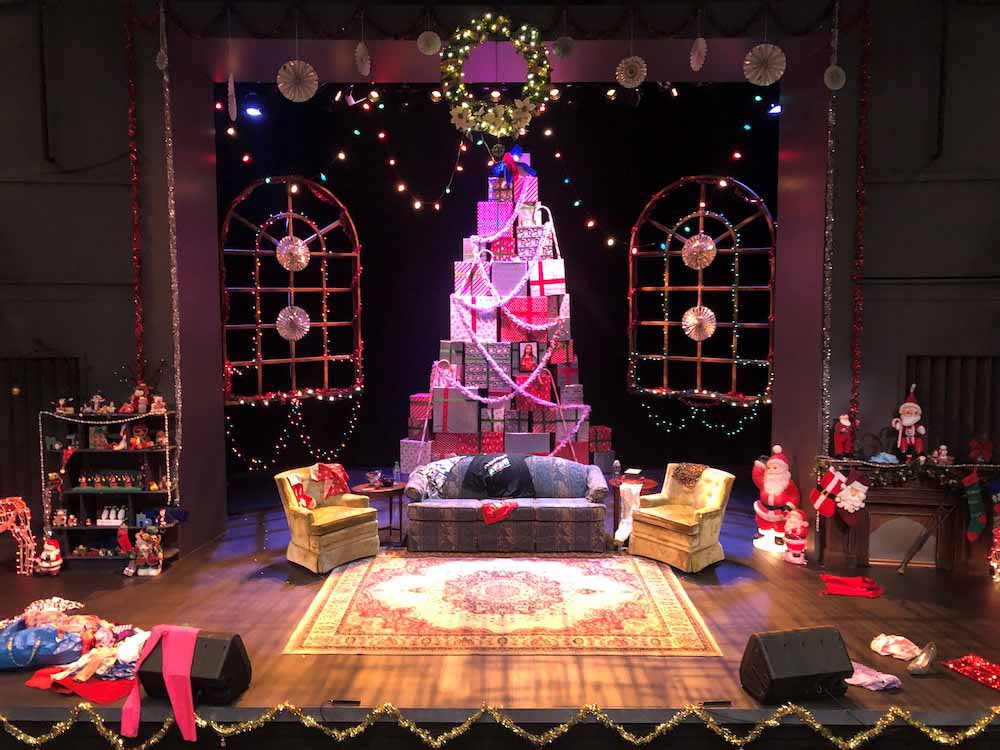
The set, designed and decorated by Thomas Howley, is almost a character in itself. An almost baroque backdrop with a tall Christmas tree looms, somewhat ludicrously, behind a faded couch, two overstuffed chairs, and a table.
Set for ‘Oy Vey in a Manger.’ Photo by Adam Immerwahr.
Surrounding the seating arrangement, and covering every surface in sight, is a manic collection of Christmas boxes, lawn and tree ornaments of every description, neon reindeer (some of which move), and numerous Santa Claus mugs. It’s a celebration of kitsch, in all its ludicrous (and almost obscene) glory.
Act One involves the need to clean up the manger for potential buyers. This is finally accomplished at the end of the act, when all the detritus is shoved into two large garbage bags.
Act Two begins with a (relatively) cleaned-up set, though the kitsch and the boxes remain. But no one comes to the open house, so the Kinsey Sicks peel off their wigs, break down the invisible fourth wall, and talk directly to the audience.
From this point on, Oy Vey is a straight—but gay—review. In “Finding Jesus,” Trixie offers a parody of a found-again Christian, raising an operatic voice that could easily shatter glass.
Some of the show’s sharpest political thrusts are aimed at the gun lobby. “The Second Amendment is only for whites,” Trampolina says, after singing the stunning “Get a Gun.”
One of Winnie’s best songs, “Nice Jewish Girls,” brings down the house. It’s a tribute to all the “yiddishe maidels” who refused to be nice, the list extending “from Lillian Hellman…to Gloria Steinem” and “from Ethel Rosenberg to Rosa Luxemburg.”
Another hit in the Semitic mode is “Don’t Be Happy… Worry,” in which Angel laments—or perhaps extols—Jewish guilt.
However, at one point, she demonstrates that you don’t need to be Jewish—or gay—to like satire aimed at anti-Semites and homophobes. Asking for a show of hands, she quickly reveals that there are more non-Jews—and more hetero couples—in the audience than Jews or gays. Surprise!
Although the characters are all described as Jewish and gay, in real life only Marken fits the bill. Jeff Manabat, the singer who plays Trixie, is a Filipino American actor who can be seen (and heard) in dozens of action films on Netflix. Brown is a veteran of the Kansas City musical stage, while Marken is active in San Franciso’s theater and light opera scene. McLendon, who plays Angel, has spent most of his career in musical theater and is a playwright too.
Oy Vey in a Manger is a wonderful reminder of a kind of comedy that has been nearly whitewashed out of existence. It’s reminiscent of burlesque, reminding me of Nathan Lane’s moving tribute to that long-gone art in The Nance. Watching the Kinsey Sicks, it’s hard to believe there was ever a time when it was illegal for female impersonators to be gay.
Running Time: Approximately one hour 45 minutes, including a 15-minute intermission.
The Kinsey Sicks’ Oy Vey in a Manger plays through December 25, 2021, at Theater J, in the Aaron and Cecile Goldman Theater, located inside the Edlavitch DC Jewish Community Center at 1529 16th St. NW, Washington, DC. Oy Vey in a Manger will also be available on-demand to stream from home from December 24 to 31, 2021. For in-person tickets, call the box office at (202) 777-3210, or purchase them online. (The box office is available from 1 pm to 5 pm Monday through Friday and one hour before a performance.) Single ticket prices range from $35–$75. Streaming tickets ($55) are available here.
Not recommended for anyone under 18 or members of the NRA.
COVID Safety: In accordance with the Edlavitch DCJCC policy, all individuals will be required to show proof of full vaccination each time they enter the EDCJCC by presenting either digital documentation on a smartphone or a physical copy of their vaccination card. Individuals with medical or religious exemptions to vaccinations will be required to show proof of a negative COVID-19 PCR test taken within 72 hours of their arrival to the EDCJCC. Mask wearing will be required inside of the building by all people at all times (except when eating/drinking in designated areas). Please do not attend if you have any symptoms of COVID or have been exposed to anyone with the virus. For more information, visit theaterj.org/safetyguidelines.
Through the pandemic shutdown, theaters reopening, and many performances currently being canceled to ensure safety, NYC companies continue to present online shows. Among the range of digital events over the holidays are free offerings of a proto-feminist Victorian comedy and a listening party for the concept album of a brand-new musical adaptation of a post-modern novel.
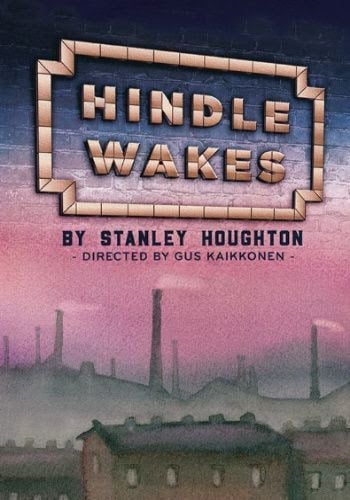
Before returning to live in-person performances in February 2022, The Mint Theater Company continues its series of virtual offerings with Hindle Wakes, available through Sunday, December 26. Running one hour and 50 minutes, the video is an archival recording of its 2017-18 Off-Broadway stage production – the first US revival of the controversial work in nearly a century.
Written by English playwright Stanley Houghton (1881-1913), the hit comedy, which premiered in London in 1912, sparked both critical acclaim and moral outrage with its bitingly candid look at two young people in the Victorian era in search of pleasure without commitment. Set in the provincial town of Hindle in Greater Manchester, the mill is closed for the old Wakes Week holiday and the workers have time off. Fanny Hawthorn and a girlfriend take a trip to the seashore, where she runs into the mill owner’s son Alan Jeffcote. He takes her to a hotel in Wales for a few days of fun, until their parents find out and the fun stops. Is she a gold-digger, will the families pressure them into marriage, or was she just having a good time for the weekend? Houghton, a prominent member of the Manchester School of dramatists, wrote more than a dozen plays, many of which, like this one, called for women’s sexual and economic freedom.
Hindle Wakes plays on demand through Sunday, December 26, 2021, at The Mint Theater Company website. To view, go online.
The newly launched production company The Bad Kids – designed to create a community-based platform that funds, develops, and promotes new and original theatrical works – will introduce itself to audiences with a year-end listening party of a concept album for the new musical How to Repair a Mechanical Heart on December 30.
Based on the 2012 novel by J.C. Lillis, the original adaptation, conceived and directed by Marc Erdahi, with a book and lyrics by Jay Falzone, music by Trent Jeffords, and musical direction is by Julianne B. Merrill, puts a modern queer twist on a romantic comedy about first love, fandom, and finding the courage to be yourself, when Brandon and Abel, two very different guys, meet in an online fanfiction group devoted to their favorite sci-fi TV show Castaway Planet, and then maybe fall in love at the fan-con.
JJ Niemann. Photo courtesy of the artist.
The special event, hosted by Tik Tok star JJ Niemann (Book of Mormon Ratatouille; The Tik Tok Musical), will include cast and creative team members, special guests, giveaways, and new music. The concept album features Broadway’s Troy Iwata (Be More Chill), Chris Medlin (Diana; Mean Girls), Ben Roseberry (The Lion King), and Ben Bogen (Frozen), along with Off-Broadway and regional artists Trey Harrington, Maria Habeeb, Lily Talevski, Stephen Smith, Mara Jill Herman, John Jeffords, Katelyn Lauria, Pilar Martinez, and John Rodney Turner.
How to Repair a Mechanical Heart plays on Thursday, December 30, 2021, at 8 pm, on The Bad Kids Facebook page and YouTube channel. To reserve a free digital ticket, register online.
For the first in-person production of their 2021–22 season, Imagination Stage is showing Corduroy in its East Coast premiere. The adorable children’s play was adapted by Barry Kornhauser from the two books Corduroy and A Pocket for Corduroy written by Don Freeman in 1968 and 1978.
Director Kathryn Chase Bryer, along with Scenic Designer Daniel Pinha, has created a beautiful setting of a large department store, complete with a functioning escalator simulation and various appliances that seem to run on their own.
Lisa (Ariana Caldwell) pinky-swears with her mother (Jasmine Brooks) that she will do extra chores to earn money to buy Corduroy in ‘Corduroy.’ Photo by Margot Schulman.
Corduroy, played by Alex Vernon, is a lonely teddy bear in green overalls who captures the heart of young passerby, Lisa (Ariana Caldwell). She longs to take the bear home, but her Mother (Jasmine Brooks) is too stressed and busy, adding that the bear is missing a button and isn’t worth the money. The disheartened Lisa reluctantly leaves empty-handed, but not before rushing to the bear and whispering something into his ear.
I should clarify that Corduroy is actually a magical bear that looks like your regular, run-of-the-mill stuffed animal when in the company of humans. But then he comes to life as soon as he’s alone and the transitions are quite cleverly devised.
Speaking of humans, the unfortunate Night Watchman, played by Matthew Pauli, is on duty once the store closes and takes his job very seriously. And, as one would imagine, having a magical bear on the loose is a recipe for disaster.
Corduroy (Alex Vernon) and the Night Watchman (Matthew Pauli) are on a madcap hunt in ‘Corduroy.’ Photo by Margot Schulman.
Corduroy, who has language limited to the words “friend” and “button,” decides that he needs to find his lost button and sets out to look for it. Vernon does a delightful job portraying the adventurous bear, using great facial animation and intonation to convey much more than his two-word vocabulary would normally allow.
As Corduroy finds different buttons throughout the department stores (think of the many appliance and furniture buttons out there), he leaves a path of wreckage behind him. The Night Watchman, believing there is an intruder in the mall, determines to catch the criminal.
Pauli is extremely funny as the guard, and his slapstick-y antics had the kids laughing anytime he was on stage. He gets splashed with paint, burns his pants on a stovetop, slips and falls too many times to count, and is chased by a vacuum cleaner, whose bag expands to epic proportions after running all night.
Corduroy (Alex Vernon) climbs a tower of toilet paper in search of his missing button in ‘Corduroy.’ Photo by Margot Schulman.
While these shenanigans are going on, over in the home of Lisa and her Mother, another sort of disaster is underway. Lisa’s Mother has agreed to let her earn enough to buy Corduroy herself by doing extra chores around the house. But unfortunately, Lisa is as clumsy as she is eager. And while her Mother tries to keep her cool, as her little girl clogs her sink, shrinks her favorite sweater, kills her prized plant, and breaks the trash can (leaving garbage all over the newly cleaned floor), it is apparent that Lisa is wrecking her chances of acquiring the extra money.
Brooks and Caldwell interact together very naturally, and their loving relationship feels honest. Caldwell effuses such innocence and genuine remorse that it appears natural that Lisa never gets into real trouble, and Brooks masters the motherly art of internally losing her mind while acknowledging that her daughter’s unfortunate mistakes are entirely blameless.
The whole production was well done and the kids in the audience were obviously and audibly enjoying themselves. I was seated next to two youngsters who kept shouting warnings to the poor Watchman and then cackling at his mishaps.
The overall message of the show encourages love, family, and patience for adults and children alike. A little girl who has to earn a prize for herself, and a mother who teaches her the value of effort and honesty.
Lisa (Ariana Caldwell) is reunited with her beloved bear in ‘Corduroy.’ Photo by Margot Schulman.
Corduroy is a fun adventure, making for a nice outing for families with young children. Congrats to the creative team for making the “magic” look real. Imagination Stage’s light-hearted production brings laughter to feed the soul and inspire young minds.
Running Time: Approximately 90 minutes, with no intermission.
Best for ages 3 to 9.
Corduroyplays through January 23, 2022, at Imagination Stage, 4908 Auburn Avenue, Bethesda, MD. Tickets ($28) are available to purchase online or by calling the box office at (301) 280-1660.
COVID Safety: Ticket holders ages 12 and older must provide proof of COVID-19 vaccination and, for ages 18 and older, photo ID for all performances. (Starting with P.Nokio performances in February 2022, those ages 5 to 11 will be included in this vaccination policy.) Imagination Stage’s complete COVID safety measures are here.
CREDITS
Based on the Corduroy and A Pocket for Corduroy books by Don Freeman Licensed by CBS Consumer Products Adapted for the Stage by Barry Kornhauser Directed by Kathryn Chase Bryer
Cast: Jasmine Brooks (Mother), Ariana Caldwell (Lisa), Matthew Pauli (Night Watchman), Alex Vernon (Corduroy), Edmée Marie Faal (Understudy for Mother/Lisa), Jon Kevin Lazarus (Understudy for Corduroy/Night Watchman)
Creative Team: Daniel Pinha (Scenic Designer), Frank Labovitz (Costume Designer), J. Mitchell Cronin (Lighting Designer), Justin Schmitz (Sound Designer), Sarah Tundermann (Projections Designer), Mark Jaster (Movement Coordinator), Kate Kilbane (Production Stage Manager), Matthew Pauli (Props Consultant), Stella Pugliesi (Assistant Scenic Designer), Alex Vernon (Movement Assistant), Amith Chandrashaker (Lighting Design Advisor), Katie Moshier (Deck Captain), Olivia Viola (Covid Safety Manager/Wardrobe Crew), Laura Sperling (Production Manager), John Elder (Technical Director), Bethany Regalbuto (Master Electrician), Anna Klinger (Costume Shop Manager), Ren Brault (Assistant Technical Director), Danielle Harris (Scenic Charge Artist)
The national touring company of Pretty Woman: The Musical comes to DC’s National Theater for eight performances from December 28, 2021, to January 2, 2022. Olivia Valli, the rising star who plays Vivian, talked with DCMTA’s Bob Ashby about how the show has been revised since its Broadway run and how her character will be different from Julia Roberts’s in the movie. This interview has been edited for length and flow.
Bob Ashby: You are playing a role made famous by Julia Roberts. How does your Vivian differ from hers?
Olivia Valli. Courtesy of Broadway at The National.
Olivia Valli: I’m going to be giving more of a Jersey flair to it. I’m a naturally witty person, and I like to use humor to cope or get through tough situations, so that’s what I lean into. I also like trying to see the good in people, and that’s something I focus on, because the writing for the show is different from the movie, and so is the direction. Vivian in the show is more of an open-hearted person, even though she’s in extreme and unfortunate circumstances with her line of work. Jerry Mitchell [the director] always reminds me to see the hope rather than get so down so quick. You’ll see more of a character that chooses hope.
One of the songs in the show talks about Vivian’s backstory, how she got into her line of work. Beyond that, what sort of backstory do you imagine for the character?
The backstory that you’re going to get for Vivian is a not-so-gentle reminder is that her line of work [prostitution] is not always a choice. There’s an awareness of that. Five minutes into the show she starts singing “Anywhere but Here.” She just wants to get out, she wants to do different, she wants better for herself. She doesn’t know how, but she’s going to get there, and that’s what drives her through the entire show. Right from the jump you see a go-getter who really believes that she wants better but she doesn’t necessarily see it for herself yet. She just knows innately that she wants it.
Do you think that Vivian sees her sex work as a valid sort of work, or is it something she feels a need to be rescued from?
I think that for Vivian, she’s more along the lines of it might be OK for Kit [the secondary female lead] or for somebody else, but just not for her. I don’t think there’s judgment attached to it; I just think that she knows that she’s unhappy and wants to move forward.
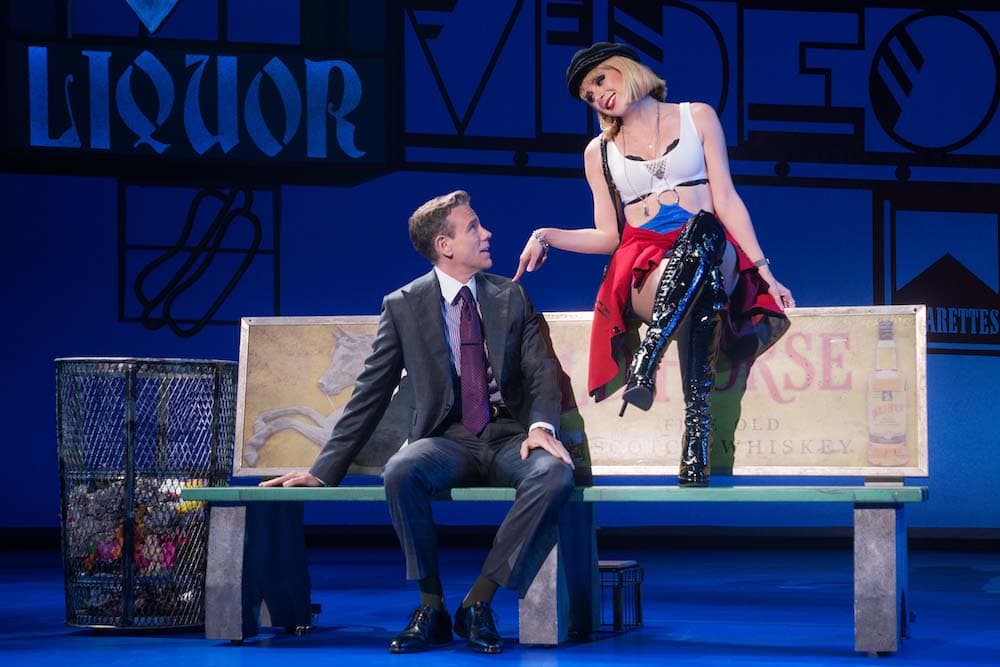
Jessica Crouch (as Kit De Luca) and Olivia Valli (as Vivian Ward) in ‘Pretty Women.’ Photo by Matthew Murphy for MurphyMade.
How do you think the songs in the show cast a different light on Vivian and the other characters, compared with the film?
Since it’s theater it’s going to be bigger and more exaggerated, but if anything the musical tends to a more in-depth perspective for every character than might have been in the movie. Like for Edward [the male lead], you start to see the wheels turning immediately when he meets her: What is it about this girl he can’t stop finding himself attracted to? What is it about Vivian that she might be down but she’s not out — like when she’s turned down at a shop for the first time, or when she’s singing “I Can’t Go Back”? Or you’ll see the backstory on Kit, which is really special, because rather than getting a blip in time like in the movie you’re getting a full backstory. You start to understand where people are coming from, years before, and I think that makes the show more relatable. In every situation, whether it be Edward or Vivian or Kit or the Happy Man/Mr. Thompson, you resonate with those characters in one way or another.
Is the show set in the time period of the movie or has it been updated?
It’s set in the late ’80s, early ’90s, just like the film.
Given that gender roles and perceptions of sex workers are different now from what they were 30 years ago, how does that get taken into account in this version?
After the Broadway run, the Pretty Woman team trimmed the fat on what did and didn’t work, and updated a lot of the book. This book focuses more on Vivian’s choice — and when she’s not being treated well, she says, “I don’t want to be treated like this.” She doesn’t care about the money, or the status, or the offer of a better life. She wants to be valued first and respected, regardless of her line of work, and so she’s willing to walk away, no matter what. There’s a point in the show where she turns down the money, the $3,000, and the scene really emphasizes “don’t ever treat me like this again” — that you are treating me like this is unacceptable, regardless of who I am or what I do.
It’s interesting to see how the show is perceived. I’ve passed by people in different cities where it’s “Oh, it’s the show about the hooker,” but in other cities it’s “Oh, it’s Pretty Woman, the love story, the romance, the Cinderella story.” Even though we think we’ve made a lot of strides when it comes to changing the perception of sex work, we kind of haven’t. In a lot of places, we’re still kind of stuck in that late ’80s/early ’90s mentality.
From what I’ve read of the 2018 Broadway production, it had so-so box office and a tough reaction from critics. From what I’m hearing now, there have been some tweaks to improve what may not have been working as well in New York.
We were just in Chicago, and I was a little nervous about that because that was where the pre-Broadway run was, and it didn’t do very well there, because it is what it is. They liked it, but there were still a lot of problems. A huge testament to the changes in the show is that when we did it in Chicago on tour, they really loved it, and they thought the updates were great. It feels better, it doesn’t feel as extreme, it feels like a real and grounded story. And that’s what we’ve been getting time and time again. It’s just that the topic of the musical can sometimes be touchy for some people. Overall, people are happy with the changes, which makes me excited, because I do confidently feel that this is a really solid story that people can go to and escape the horrors of the world and enjoy themselves with.
Adam Pascal (as Edward Lewis) and Olivia Valli (as Vivian Ward) in ‘Pretty Women.’ Photo by Matthew Murphy for MurphyMade.
In this story, like so many others over the years, we’re looking at a wealthy man and a beautiful woman, traditional currency of what one might call transactional relationships. So can you speculate, if Edward isn’t as rich, or Vivian is just an average-looking woman in that line of work, does the story come out differently?
I feel the story would come out the same because Vivian isn’t swayed by money or status; she has to earn money or she’ll get kicked out onto the streets of LA, and the streets of LA are hard. There’s a line that says, “We could have died tonight.” She’s very aware of the very dire circumstances, but she still turns the money away because she finds herself and she finds her voice. She doesn’t care who you are, she’s going to demand respect.
This is a story about two people falling in love, and I think that Edward still would have fallen for her crazy nature in the sense that she sees the world through this new set of eyes, and she’s not afraid to say no, and she’s not afraid to challenge people. But she also chooses to see the good in people. This story, especially our version of the story, emphasizes falling in love with the heart of a person. Two people who do not necessarily fit into their worlds — Edward doesn’t really fit into his, Vivian doesn’t fit into hers — create their own, and that’s kind of what happens in a relationship anyway — you come together with a person, and you create your own safe world where there is mutual respect, admiration, and love. I think it would have turned out just the same because it’s two people who fell in love with one another’s hearts rather than their material circumstances or outer exteriors.
Why should I or someone come to see this show?
Because as much as this is a Cinderella story, this is an underdog story. I think we’ve all felt like the underdog in one way or another, whether you’re judged off of what you do or the money you make, your gender, or how you dress, or even, in Edward’s world, you’re treated differently if you’re not the rich billionaire. I think that we have all felt stepped on or taken advantage of or we deserve more respect than we get, and this is a story about watching somebody find their voice, and everybody can resonate with that, because in one way or another we all do that, whether that be big and grand or more subtle, we all have felt like, OK, I’m going to rise above my circumstances and go for my dream, and I’m going to go and change, because I deserve basic human decency. So I feel that people who have felt like an underdog can come and really sympathize with that and go, Hell yeah, I’m going to root for these people because I’ve been there.
Pretty Woman: The Musicalplays from December 28, 2021, to January 2, 2022, at the National Theater, 1321 Pennsylvania NW, Washington DC. Tickets ($50–$110) can be purchased online. The show runs two hours, 30 minutes, including one intermission.
UPDATE from Broadway at The National, December 23, 2021:
Despite robust precautions, breakthrough COVID-19 cases were identified within the fully vaccinated touring company of PRETTY WOMAN: THE MUSICAL prior to traveling to Washington, DC. As the affected company members complete their recovery—and to ensure the wellness and safety of our guests, cast, and crew—all performances of PRETTY WOMAN: THE MUSICAL at The National Theatre (December 28, 2021 – January 2, 2022) have been canceled. We apologize for the disappointment and inconvenience. Ticket holders are being contacted now with a variety of options, including refunds, and should contact their point of purchase with any questions.
COVID Safety: The National Theatre’s vaccination and masking policies are here.
Since theater in 2021 began online, we decided to start our annual staff favorite listings by recognizing the digital material made during the unprecedented 18-month closure of the theater industry. Theater makers across the DC metro region stepped up to the challenge of pivoting to online material, often with stellar results. Here are the online shows that wowed our critics. All of these outstanding productions were created for digital viewing or listening during the pandemic.
Ro Boddie as Jay in ‘A Boy and His Soul.’ Photo by Harold F. Burgess II.
A Boy and His Soul, Round House Theatre
A beautiful piece of art celebrating Black joy, genuine love, and Soul music. Jay, a young man, returns to his childhood home to prepare it to be sold. In the basement, he comes upon crates of abandoned records and begins reminiscing about his family, the deep love his parents had, his acceptance of himself, coming out to his family, and the music that filled their home and guided his life. Ro Boddie is brilliant as Jay, a character who carries the confidence and passion of a man bursting with a story to tell. There is a second star of the show, the music, a blend of disco, R&B, and classic soul. The songs ebb and flow throughout the production, at times taking over the moment and lulling Jay into the memory of the song, sometimes singing along, sometimes swaying, and always carrying the audience with him. Read Kendall Mostafavi’s full review.
Kuhoo Verma in Rona Siddiqui’s ‘A More Perfect Union.’ Photo courtesy of Arena Stage.
A More Perfect Union, Arena Stage
Writer/Composer Rona Siddiqui imagines her relationship to America as a troubled romance in three songs in A More Perfect Union, a thrilling and joyous accomplishment, dazzlingly illustrated and breathtakingly performed. Siddiqui describes this work as an EP. And, indeed, it may be more recognizable to you as a set of three music videos, linked by a theme. Regardless of what you call it, it’s worth watching several times. Read Gregory Ford’s full review
Christopher Jackson, Nova Y. Payton, and the cast of ‘After Midnight.’ Photo by Christopher Mueller.
After Midnight, Signature Theatre This vaudeville-like show — conceived by Jack Viertel, featuring the poetry of Langston Hughes — conjures up memories of dancing in nightclubs up and down the East Coast in the late 1950s. After Midnight features a cast of 12, headlined by Christopher Jackson, Nova Y. Payton, and Mark G. Meadows, who keeps things lively with his band of seven musicians. It’s tough to pinpoint an exact classification of Director/Choreographer Jared Grimes’s nonstop physical movement — a shoulder roll here, a slap on the thigh there, and enough hip-shaking to have worn out Elvis Presley in his prime. Some critics may suggest After Midnight works better in person on a proscenium stage. For me, though, I plan to watch this show over and over again. The filming, editing, lighting were all superb. Read Carolyn Kelemen’s full review
All the Devils Are Here: How Shakespeare Invented the Villain, Shakespeare Theatre Company
STC’s first online-only production, All the Devils Are Here is adapted from the works of Shakespeare, written by and starring Patrick Page. The subject is the evolution of Shakespeare’s villains, from stock characters to multifaceted human beings. At every point, Page skillfully sets Shakespeare’s words in context, reminding us that the Elizabethan audience was full of arbitrary prejudices. In All the Devils Are Here: How Shakespeare Invented the Villain, Shakespeare Theatre Company Affiliated Artist Patrick Page brings us a different kind of magic: the artistry of an actor who has studied his characters deeply and understands them in every detail. Read Sophia Howes’ full review
Heather Christian in the original film adaptation of the Bushwick Starr’s production of ‘Animal Wisdom.’
Animal Wisdom, Woolly Mammoth Theatre Company
Heather Christian’s autobiographical revival concert rocks Woolly Mammoth — virtually. Christian prepares the audience for a Requiem Mass so that we can prepare our hearts and minds for the spirits that are not yet in repose: “This is not a TV show. This is not a theater show. This is… something else.” The autobiographical piece is more of a tent revival rock concert than Catholic Mass, but it still upholds the deep traditions of storytelling and spirituality. The film was produced jointly by The Bushwick Starr, American Conservatory Theater, and Woolly Mammoth Theatre Company and was filmed on location in March 2021 at Woolly Mammoth in DC. The original stage direction of Emilyn Kowaleski is adapted to the screen by Director Amber McGinnis. McGinnis finds the tricky balance of intimate closeups, handheld shots, and widescreen angles so that the viewer can stay engrossed without feeling overwhelmed or disconnected. Read Laura Mills’ full review
Sue Jin Song in ‘Children of Medea.’ Photo by DJ Corey Photography.
Children of Medea, Constellation Theatre Company
Cynthia, 17, the main character in Sue Jin Song’s brilliant Children of Medea, has been abandoned by the one person who could theoretically guide her. Her mother has simply disappeared, leaving her to care for her 10-year-old sister, Julianne, with a father who is distant and always at work. Like many a gifted teenager before her, Cynthia takes refuge in her imagination. The unbearable pressure of her trauma, as well as her own talents, propels her into other times and other worlds. She is Alice in Wonderland, falling down the rabbit hole. She is Euripides’ Medea, in love with her consort Jason and scorned by him. Read Sophia Howes’ full review
Cock, Studio Theatre
Directed by David Muse, as was the 2014 Studio production, Cock is a rock-solid, remastered-for-camera version of the Helen Hayes Award–winning play in a taut, tight performance on a spare set. Mike Bartlett’s characters deliver tasty morsels of spicy, pointed, hissy dialogue and rapier-sharp active wordplay along with comic moments to sugar up the tartness and pain. In its own way, Cock is a schoolyard brawl or perhaps a bare-knuckles boxing brawl. The technical production design is a winner. The dialogue and words and the film editing bring it all to powerful view. Read David Siegel’s full review
Detroit ’67, Signature Theatre Played out in a basement bunker, this uplifting virtual show spins on nostalgia and desire. The talent is top-notch. Written by prize-winning playwright and Detroiter Dominique Morisseau, Detroit ’67 sews up Signature Theatre’s Signature Features virtual season with slice-of-life precision, focusing not on the city at large but on one household on the verge of splintering. It’s a history lesson presented by director Candis C. Jones with respect, nostalgic flair, and soul-ripping realism. Read Terry Byrne’s full review
Deidra LaWan Starnes as Wendy and Geoffrey Rivas as Mac in ‘Duck Harbor,’ episode 8. DCMTA screenshot.
Duck Harbor, 1st Stage In what became an addictive web series of 12 extraordinary weekly episodes, Duck Harbor told a heartwarming story of long-distance love in later life. The two performers, Geoffrey Rivas and Deidra LaWan Starnes, were secretly cast; neither knew who the other character would be until the moment that the scene started. To enhance the spontaneous theatrical magic, each actor was given only his/her lines in the script several days before filming, with the other’s redacted so they were unaware of each other’s text. Writers Bob Bartlett and E. M. Lewis collaborated over months working through ideas and concepts to develop the scenes and episodes. Director Alex Levy helped to make sure that the tone, intent, and purpose come through as the script unfolded. Then it was up to the actors, working without a net, to find their voices using their own instincts in portraying the characters and where they were moment-to-moment with each other. Read Debbie Minter Jackson’s episode-by-episode review of the series.
Justin Weaks (foreground) and DJ Nick tha 1da in ‘Flow.’ Photo courtesy of Studio Theatre. Video Production by Studiio Box DC.
Flow, Studio Theatre Director Psalmayene 24 and actor-poet Justin Weaks join forces in Flow, bridging the gap between Old Skool rappers and new age Flowetry performers to trace the tragic footsteps of seven self-styled street storytellers. DJ Nick “the 1da” Hernandez sets a mystical mood with his blue sample keyboard propped on a double stack of milk crates holding vintage vinyl. But it is Justin Weaks’s seamless stream-of-character monologues and dialogues that carry the 90-minute mindbending journey through dangerous curves and blind corners. Read Malcolm Lewis Barnes’s full review
Justin Weaks, Louis E. Davis, Gary L. Perkins III, and Shannon Dorsey ‘The Freewheelin’ Insurgents.’ Photo courtesy of Arena Stage.
Freewheelin’ Insurgents, Arena Stage
A thoughtful and exhilarating 23-minute black-and-white film, Freewheelin’ Insurgents is Psalmayene 24’s contribution to Arena Riffs, a three-part, commissioned, filmed musical series that is a project of Arena Stage. A “Riff” seems like an especially appropriate label for work that encourages its characters and its audiences to give themselves permission to give attention to the unsettling moment they are living through so that they can imagine a tomorrow. Read Gregory Ford’s full review
The cast of ‘Ghost/Writer’: Steve Polites and Dane Figueroa Edidi.
Ghost/Writer, a radio play from Rep Stage Playwright Dane Figueroa Edidi mixes romance and vengeance and packs volumes of truth into language that alchemizes profound insights about racial injustice and sensuality. The play shifts place and time dramatically in ways that would take considerable stagecraft to achieve. As a radio play, though, the beautifully written narration Edidi has given her characters, combined with evocative sound effects, serve to invite us into worlds and otherworlds and fly us through time. We are left in our mind’s eye to set the scenes and take in the story. And what a story it is. Read John Stoltenberg’s full review
Director Ayesis Clay and actor Karen Lawrence during ‘Girls’ Night’ recording session. Photo courtesy of The Welders.
Girls’ Night (with Spirits), an audio play from The Welders
An immersive and enjoyable audio play by Teshonne Nicole Powell about a Black woman who believes her home is being haunted. The second production from Welders 3.0, the third cohort of the DC playwrights collaborative, The Welders. Girls’ Night is unique in that Powell has chosen to present this exploration of the terror and healing in the lives of Black women as a radio drama. The narrative of Girls’ Night follows Rey, a Black millennial woman, who believes her home is being haunted. The presence of the ghost forces Rey to finally begin to face up to a shameful secret she has been struggling with and that comes into tangible focus as her home literally begins to crumble around her. Read Debbie Minter Jackson’s full review Read Gregory Ford’s interview with Playwright Teshonne Nicole Powell
Craig (Craig Wallace) and Maboud (Maboud Ebrahimzadeh) in ‘Homebound.’
Homebound, Round House Theatre Ten episodes written by ten different DC-area playwrights about ordinary (and extraordinary) life during the pandemic. The same two main characters are played throughout by Maboud Ebrahimzadeh and Craig Wallace. Directed by Ryan Rilette and Nicole A. Watson, an ambitious, fascinating, and well-executed weekly series that kept us connected to of-the-moment theater and, in a way, to one another. Read Michael Poandl’s episode-by-episode review of the series
Fargo Tbakhi and Dina Soltan in Episode 1 of ‘Keffiyeh/Made in China.’ Screenshot courtesy of Mosaic Theater Company.
Keffiyeh, Made in China by Dalia Taha, Mosaic Theatre
In choosing to offer Keffiyeh: Made in China, Mosaic Theater has gifted us just that — a mosaic of short and trenchant pinhole theatrical views into the everyday tensions, fears, and losses experienced by the Palestinian people. While we all hope to return full-time to theaters worldwide, Mosaic’s successful online effort reminds us that we don’t have to sacrifice connectedness and artistic excellence even in these challenging times. Keffiyeh, Made in China is a haunting seven-part series of short plays featuring fabulous writing and great performances, all very well-suited to online viewing. Read Amy Kotkin’s episode-by-episode review
Christian Douglas and Sam Bolen in ‘Midnight at The Never Get.’ Photo by Christopher Mueller.
Midnight at the Never Get, Signature Theatre
Trevor, a colorful and campy singer, and Arthur, a coy and talented songwriter, are trying to climb the ladder of the NYC nightclub scene while navigating the dangers of being gay men in a time when their love and the music they wanted to create was illegal. Told through the memories of Trevor, this vibrant and poignant musical (book, music, and lyrics by Mark Sonnenblick) follows the Friday night performances of their act of love, identity, and belonging set to Arthur’s Cole Porter–esque tunes. Directed by Matthew Gardiner, this nightclub musical combines the shmaltz of a cabaret with the pull of a Eugene O’Neill play to create something truly transporting, all from the comfort of your own home. Sam Bolen gives an astounding performance and Adam Honoré’s lighting was a triumph. Read Em Skow’s full review
The artists of ‘Night at Newcastle’: Andre Hinds, Alan Naylor, and Rachel Felstein.
Night at Newcastle Featuring outstanding live performances by Rachel Felstein, Andre Hinds, and Alan Naylor, Night at Newcastle was a weekly cabaret that enjoyed an extraordinary live run online. Their Facebook page modestly refers to themselves as a “group of DC Professional artists living, quarantin[ing], and singing music together to make the time pass by.” In what has to be one of the most inspired and sustained artistic responses to the COVID shutdown, these three extraordinary local theater talents (who happened to be housemates) began in April 2020 to perform original weekly cabaret concerts live, usually on Thursday nights, occasionally with special guests. A loyal audience of fans followed, grateful to behold in real time what makes musical theater performance beloved. Night at Newcastle’s finale was in July 2021, but videos of some of their most popular concerts can still be enjoyed online.
Jordan Friend
Old Soul, 4615 Theatre Company Jordan Friend’s narrative concert — a tour de force on the trauma of turning 25 — is stunning in its intensity, power, honesty, and humor. Friend — whose company, 4615 Theatre, was named Best Emerging Theatre in last year’s Helen Hayes Awards — is enormously talented. He wrote and performed all the material. The result is outstanding in its range and its unexpected juxtapositions, both hilarious and painful, funny and scary to watch.
Benjamin Williamson and Paula Sides in ‘Orphée et Euridice.’ Photo courtesy of IN Series.
Orphee et Eurydice, IN Series
This modern retelling of Gluck’s classic 1762 opera features real-life married couple Benjamin Williamson and Paula Sides, along with their children Aurelia and Elijah, singing an English translation by Andrew Albin, while filmed in their home by Jan Capinski and directed by Timothy Nelson, with musical direction by Simone Luti. Williamson perfectly captures a husband and father grieving the loss of a loved one. This production felt right for a world where we are reeling from so many deaths from the pandemic. Read Charles Green’s full review
Agnes (Emma Wesslund) faces down against Tiamat, a five-headed dragon, puppeted by the cast in ’She Kills Monsters.’ Dragon puppet and photo by Leigh K. Rawls.
She Kills Monsters, Silver Spring Stage
The design elements are incredibly well-done in this production, in which a teacher becomes deeply involved in her deceased teenage sister’s Dungeons & Dragons-style roleplaying game scenario. Lighting Designer Stephen Deming transitions seamlessly between the “real” world and the game world and uses shadow puppets at the beginning. Set Designer Leigh K. Rawls and Costume Designer Stephanie Yee have a cleverly done design for the “big bad” that the party faces at the end. Fight and Intimacy Director Sierra Young gives the battles a stylized feel while remaining exciting and uncertain, one battle even done in slow motion. Choreographer KT Aylesworth gives the actors many great movements, some even doing cartwheels. Read Charles Green’s full review
Da’Von T. Moody as Jermal and Cormac Elliott as Connor in ‘Side-Walks.’ DCMTA screenshot.
Side-Walks, Solas Nua A commission by Dublin-based artist John King and DC-based artist Jeremy Keith Hunter, Side-Walks is a beautifully told visual short story that celebrates the complexity and fluidity of human existence. Designer Patrick W. Lord and Director/Composer Rex Daugherty create a seamless experience of sites and sounds with a track that plays perfectly into the journey, guiding the pace and tone. Carrying the story into an almost musical experience at times. But the narrators are the core of the story. Cormac Elliott voices Connor, a young man from Northern Ireland, going to school in Dublin, who ultimately makes his way to the States. And Da’Von T. Moody is Jermal, a young student from the U.S., who finds himself headed to Dublin with a friend for a fun, easy adventure. Read Kendall Mostafavi’s full review
Miss Kitty (Specs), Danielle Gallo (Tank), and Ryan Sellers (Locksmith) in ‘The Spy Academy: The Heart of the Dragon.’ Photo courtesy of Imagination Stage.
Spy Academy and the Lost Treasure of Atlantis, Imagination Stage
A fantastically entertaining conglomerate of action, adventure, suspense, and pure silliness perfect for ages 5 and up. While kids were stuck at home at the height of COVID, Imagination Stage gave them an outlet for their imaginations. Remember Choose Your Own Adventure books? Spy Academy let kids chime in on how the story should advance and felt like a live-action immersive video game. Conceptualized by Strother Gaines and written by Doug Robinson, the piece is co-directed by Gaines and Jeffrey Eagle, and the action switches between live interaction and recorded sequences (filmed by Leapfrog Productions) with news clips or security footage of the spies on assignment. Read Kendall Mostafavi’s full review
Travis Schweiger as Vince, Chelsea J. Smith as Amy, and Neal Davidson as Jon in ‘Tape.’
Tape, The SharedScreen: This scorching live production of Stephen Belber’s 1999 play is a successful experiment in embracing the present virtual reality of theater. With the playwright’s permission, Tape was adapted by Neal Davidson specifically for the Zoom platform. Instead of a meetup in a motel room with three old friends, as the original script dictates, this production is framed as an actual video call. By adapting Tape so that Zoom is integrated into the piece from the bottom up, Davidson normalizes the format, effectively rendering the video call platform, such an encumbrance in other pandemic pieces, almost invisible. By making the format incidental to the piece, Davidson allows the keen writing and brilliant performances to shine. Read Michael Poandl’s full review
Jared Shamberger in ’The B Word.’ Photo courtesy of The Welders.
The B Word, The Welders
The first production by Welders cohort 3.0, The B Word by Jared Shamberger is inspired by and devised from interviews with Black gay men across the DC, Maryland, and Virginia area who were asked to speak about the intersectionality of race, gender, and sexuality. Directed by Raymond O. Caldwell and filmed in a documentary-style format, it allows for an examination of how the concept of beauty functions in the lives of Black gay men. Read Debbie Minter Jackson’s full review Read Gregory Ford’s interview with Playwright Jared Shamberger
Jade Jones as Bonita and Louis Davis as Do or Die, members of rap crew Key Enterprises; Bayou Elom as Sgt. Pepper and Emmanuel Kyei-baffour as Ty, members of rap crew Lock Music, in ‘The Blackest Battle.’ Photo courtesy of Theater Alliance.
The Blackest Battle, Theater Alliance
Director Raymond O. Caldwell’s realization of Psalmayene 24’s The Blackest Battle — a graphic novel come to life as a hip-hop musical — is a feast of virtuosity. Whereas some have been frustrated with not having access to live theater, Theater Alliance has taken this opportunity to offer something that some of us might not sit still for in the usual sanctum sanctorum of live theater. In fact, the point of this production is kind of to make us not be able to (or want to) sit still or sit back. The Blackest Battle presents theater that more fully engages the potential of hip-hop than is often possible in “legit” stages where traditional audiences may come with curated expectations and sometimes merely tolerate the hip-hop form and keep its power at a distance. This production, though onscreen, is an immersive experience. Read Gregory Ford’s full review View a photo gallery of images from the show
Cormac Elliot and Da’Von Moody in ‘The Emoji Play.’
The Emoji Play (??????), Solas Nua Playwrights Jeremy Keith Hunter (DC-based) and John King (Ireland-based) use audience participation in a refreshingly original, boundary-pushing comedy that both comments on our times and navigates around them to provide something that isn’t quite theater, but isn’t not theater either. ??????? is “staged” on two platforms: Zoom and WhatsApp. The premise is that we the audience are “students” taking a Zoom class about digital language. The two instructors are Da’Von Moody (of Silver Spring) and Cormac Elliott (of London). The show is about the relationship between Cormac and Da’Von, and about Cormac’s recent breakup with his ex-boyfriend. Along the way, audience participation is requested via a shared WhatsApp thread, and a sort of flash community was generated between the two actors and audience members. At one point Cormac says, “Knowing that people are with you—it’s nice, right?” And it really is. Read Michael Poandl’s full review
Ramsey Faragallah as Dad and Yousof Sultani as Son in ‘This Is Who I Am.’ Photo credit: PlayCo / Woolly Mammoth Theatre Company.
This Is Who I Am, Woolly Mammoth Theatre Company
Ramsey Faragallah and Yousof Sultani play a father and son on a Zoom call from Palestine and America, respectively, while cooking a beloved meal. They give such compelling, intimate performances that it feels like eavesdropping on a private conversation. Set Designer Mariana Sanchez turns the actors’ real-life kitchens into stages, subtly highlighting the difference between the two. Lighting Designer Reza Behjat makes the light look natural while keeping the performers and their kitchens visible. Sound Designer James Ard makes sure the actors can be heard while throwing in traffic sounds just as the camera opens. Before that, a piano plays a haunting note. Video Systems Designer Ido Levran provides a clear, seamless picture that softens the feel of technology. This production blends the best aspects of live-action and technology. Read Charles Green’s full review
Home haircut: James Jelin (Jamie). DC Theater Arts screengrab.
This Zoom Life, Washington Improv Theater Nothing else I’ve seen created with Zoom during COVID comes close to the comic achievement in this web series about millennials and their socially distanced dilemmas. Its wit and absurd verisimilitude are an utter delight. This Zoom Life was created by Peruvian comedian Erick Acuña in a partnership with Washington Improv Theater (WIT). It zeroes in on the zeitgeist with so many zingers and such zest that when I came to the end I could not help but want more. (This Zoom Life is still playing on YouTube in five episodes, each about seven minutes long.) Read John Stoltenberg’s full review
Lisa Stephen Friday in ‘Trans Am.’ Photo by Cameron Whitman Photography.
Trans Am, The Keegan Theatre
Lisa Stephen Friday is an actress and singer. This one-person show, interspersed with music, is her story. She is ambitious, driven, and trans. With help, she learns to face the enormousness of what it is to be trans in America. Loss of childhood. Inability to grow up female. Being told that she is shameful, degenerate, worthless. The struggle with internalized transphobia. In her last musical number, she reminds us, she is “A-OK,” having shed the self-hatred caused by her oppression. The music of Lisa Jackson & Girl Friday is a provocative counterpoint to the dramatic highlights of Lisa’s story. Yes, Lisa, you are indeed A-OK! You are an inspiration to us all. (Trans Am will enjoy a live production at The Keegan Theatre this January.) Read Sophia Howes’ full review
Ora Jones, Billie Krishawn, and Felicia Curry in ‘Until the Flood.’ Photos courtesy of Studio Theatre.
Until the Flood, Studio Theatre Dael Orlandersmith’s Until the Flood brings the viewer into the conversation. You couldn’t be more active as a listener in this simple, seamless filmed performance that has the feel of a “one take,” unedited, linear experience in time. Until the Flood is as close to actually being in a theater as you can get. The brilliant cast consists of three women, of various generations, who interconnect with composite characters created from responses Orlandersmith collected from some 60 individuals in the spring of 2015 following the shooting of Michael Brown by white police officer Darren Wilson in Ferguson, Missouri. The characters represent people with day-to-day lives, and within their few words, you find a familiarity and connection to their experiences of police violence and systemic racism. Read Jane Franklin’s full review
A Strange Loop, Michael R. Jackson’s Pulitzer Prize-winning “big, Black and queer-ass American Broadway show,” will open on Broadway in spring 2022 at the Lyceum Theatre (149 West 45th St.). The musical — directed by Stephen Brackett, choreographed by Raja Feather Kelly, and produced by Barbara Whitman along with Page 73 Productions, Woolly Mammoth Theatre Company, and Playwrights Horizons — is now playing a critically acclaimed run at Woolly Mammoth Theatre in DC, where it has been extended through January 9, 2022.
The central character of A Strange Loop is Usher: a Black, queer writer writing a musical about a Black, queer writer writing a musical about a Black, queer writer…
James Jackson, Jr. (Thought 2), Jason Veasey (Thought 5), John-Michael Lyles (Thought 3), Jaquel Spivey (Usher), L Morgan Lee (Thought 1), John-Andrew Morrison (Thought 4), and Antwayn Hopper (Thought 6) in ‘A Strange Loop.’ Photo by Marc J. Franklin.
Bold and heartfelt in its truth-telling, Michael R. Jackson’s blisteringly funny masterwork exposes the heart and soul of a young artist grappling with desires, identity, and instincts he both loves and loathes. Hell-bent on breaking free of his own self-perception, Usher wrestles with the thoughts in his head, brought to life on stage by a hilarious, straight-shooting ensemble.
Reviewing the current run of A Strange Loopat Woolly Mammoth, Peter Marks of The Washington Post describes Jackson’s musical as “marvelously inventive, exhilarating, and beautifully staged by director Stephen Brackett and choreographer Raja Feather Kelly.” He writes, “There is so much to raise the spirits here. The score, played by a five-member band conducted by music director Rona Siddiqui, boils and bubbles in an ecstatic cascade of musicality.”
John Stoltenberg of DC Metro Theater Arts calls A Strange Loopa “knockout smash” and writes, “In thematic dimensionality and depth, raw candor, and meta-theatricality, A Strange Loopis beyond compare.”
Jaquel Spivey as Usher in ‘A Strange Loop.’ Photo by Marc J. Franklin.
The show will feature set design by Arnulfo Maldonado, costumes by Montana Levi Blanco, lighting design by Jen Schriever, sound design by Drew Levy, music direction by Rona Siddiqui, orchestrations by Charlie Rosen, and casting by The Telsey Office/Destiny Lilly. Casting, dates, and ticket information for A Strange Loop on Broadway will be announced soon.
A Strange Loop made its world premiere at Playwrights Horizons in May 2019 to sold-out crowds. The show quickly became a critical favorite, praised as “exhilarating and wickedly funny” by New York Magazine’s Sara Holdren and “some of the most vital work in American theater” by The New York Times’s Wesley Morris. Following the successful run, A Strange Loop was the recipient of the 2020 Pulitzer Prize in Drama, five Drama Desk Awards, two Lucille Lortel Awards, six Outer Critics Circle honors, two Obie awards, one Off-Broadway Alliance Award, and the New York Drama Critics Circle Award for Best Musical. Playwrights Horizons’ original cast recording of A Strange Loop is available on Yellow Sound.
A Strange Loopruns through January 9, 2022, at Woolly Mammoth Theatre Company, 641 D St. NW, Washington, DC, with performances Tuesday to Friday at 8 pm; Saturday at 3 pm and 8 pm; and Sunday at 2 pm and 7 pm; Monday, December 27 at 8 pm. Single tickets start at $32 and are available online, by phone at (202) 393-3939, and via email at tickets@woollymammoth.net. Twenty-eight Pay-What-You-Will tickets are also available to every performance by selecting the PWYW seats and adjusting the ticket price. Patrons who are 30-years-old and younger may, at any time, purchase Section C tickets for $20 to any performance. There are also discounts available for educators, first responders, and active U.S. military personnel, spouses, and veterans. More information is available at woollymammoth.net.
COVID Safety: Entrance to any event at Woolly Mammoth will require proof of vaccination or, for those who are not vaccinated, proof of a negative COVID-19 PCR test taken within 72 hours of the event start time. Guests may show physical or digital proof of their health status. Masks must also be worn at all times while in the building.
MICHAEL R. JACKSON‘S (Playwright, Composer, Lyricist) 2020 Pulitzer Prize and New York Drama Critics Circle winning A Strange Loop(which had its 2019 world premiere at Playwrights Horizons in association with Page 73 Productions) was called “a full-on laparoscopy of the heart, soul, and loins” and a “gutsy, jubilantly anguished musical with infectious melodies” by Ben Brantley for The New York Times. In The New Yorker, Vinson Cunningham wrote, “To watch this show is to enter, by some urgent, bawdy magic, an ecstatic and infinitely more colorful version of the famous surreal lithograph by M. C. Escher: the hand that lifts from the page, becoming almost real, then draws another hand, which returns the favor.” In addition to A Strange Loop, he also wrote book, music and lyrics for White Girl in Danger. Awards and associations include: a New Professional Theatre Festival Award, a Jonathan Larson Grant, a Lincoln Center Emerging Artist Award, an ASCAP Foundation Harold Adamson Award, a Whiting Award, the Helen Merrill Award for Playwriting, an Outer Critics Circle Award, a Drama Desk Award, an Obie Award, an Antonyo Award, a Fred Ebb Award, a Windham-Campbell Prize, a Dramatist Guild Fellowship and he is an alum of Page 73’s Interstate 73 Writers Group. @thelivingmj (Twitter), @thelivingmichaeljackson (Instagram) www.thelivingmichaeljackson.com
STEPHEN BRACKETT (Director) Broadway: The Lightning Thief (Longacre Theater), Be More Chill (Lyceum Theater). Off-Broadway: A Strange Loop (Playwrights Horizons, Obie and Drama Desk Awards), Be More Chill (Signature and Two River Theaters),The Lightning Thief (Theaterworks USA/National Tour), Buyer & Cellar (Rattlestick and Barrow Street Theaters/National Tour), The Mad Ones (Prospect Theater), Ultimate Beauty Bible (Page 73), Wringer (NYCCT), Carnival Kids (Lesser America), The Correspondent (Rattlestick), After (Partial Comfort), The Material World (Dixon Place), Be A Good Little Widow (Ars Nova), and The Tenant (Woodshed Collective). Regional: Fall Springs (Barrington Stage), Significant Other (Geffen Playhouse), I Now Pronounce (Humana Festival), Le Switch (About Face), The Great Pretender (TheatreWorks Silicon Valley). London: Be More Chill (The Shaftsbury Theater and The Other Palace) and Buyer & Cellar (Menier Chocolate Factory). Upcoming: AD 16 (The Olney Theater) and To My Girls (Second Stage)
RAJA FEATHER KELLY (Choreographer) is a choreographer, a director, and the artistic director of the feath3r theory. He is a three-time Princess Grace Award winner (2017, 2018, 2019), two-time Lucille Lortel Award nominee (2019, 2020), and 2019 Chita Rivera Award nominee. In 2020 he was the Obie Award winner and Outer Critics Circle Award honoree for choreography for the Pulitzer-winning musical A Strange Loop. In 2019 he was an SDCF Joe A. Callaway Award finalist for both A Strange Loop and the Pulitzer-winning play Fairview. Raja is also the 2019–2020 Randjelović/Stryker Resident Commissioned Artist at New York Live Arts, an inaugural Jerome Hill Artist Fellow, and a 2019 Creative Capital award recipient. He is a current fellow of HERE Arts, the Center for Ballet and the Arts at NYU, and a Creative Associate at The Juilliard School. Over the past decade, Kelly has created fifteen evening-length premieres with his company the feath3r theory as well as directing and choreographing extensively for Off-Broadway theatre in New York City. His choreography has also garnered a 2018 Breakout Award from the Stage Directors and Choreographers Foundation (SDCF) and the Solange MacArthur Award for New Choreography (2016), and he was Dance Magazine‘s inaugural Harkness Promise Award (2018).
PAGE 73 PRODUCTIONS A Strange Loop made its world premiere at Playwrights Horizons produced in association with Page 73 Productions in May 2019 to sold-out crowds. The show quickly became a critical favorite, praised as “exhilarating and wickedly funny” by New York Magazine’s Sara Holdren and “some of the most vital work in American theater” by The New York Times’s Wesley Morris. Following the successful run, A Strange Loop was the recipient of five Drama Desk Awards, two Lucille Lortel Awards, six Outer Critics Circle honors, two Obie awards, one Off-Broadway Alliance Award, and the New York Drama Critics Circle Award for Best Musical. Playwrights Horizons’ and Page 73’s original cast recording of A Strange Loop is available on Yellow Sound.
WOOLLY MAMMOTH THEATRE COMPANY creates badass theatre that highlights the stunning, challenging, and tremendous complexity of our world. For over 40 years, Woolly has maintained a high standard of artistic rigor while simultaneously daring to take risks, innovate, and push beyond perceived boundaries. Co-led by Artistic Director Maria Manuela Goyanes and Managing Director Emika Abe, Woolly is located in Washington, DC, equidistant from the Capitol Building and the White House. This unique location influences Woolly’s investment in actively working towards an equitable, participatory, and creative democracy. One of the few remaining theatres in the country to maintain a company of artists, Woolly serves as an essential research and development role within the American theatre. Plays premiered here have gone on to productions at hundreds of theatres all over the world and have had lasting impacts on the field. These include the world premiere productions of Danai Gurira’s Eclipsed in 2009 that later went on to be the first Broadway play with a cast & creative team of all Black women; Bruce Norris’ Pulitzer-Prize Winner Clybourne Park in 2010; and Anne Washburn’s Mr. Burns: a post-electric play in 2012. Woolly produces theatre beyond our building by sending productions like Aaron Posner’s Stupid Fucking Bird across the nation and bringing Aleshea Harris’s What to Send Up When It Goes Down to neighborhoods throughout DC. A national tour of Madeline’s Sayet’s Where We Belong will launch in 2021. In addition, Woolly was the first to pioneer Pay-What-You-Will tickets in the DMV, which are now available at every single performance. Woolly Mammoth acknowledges that the theatre stands upon occupied, unceded territory: the ancestral homeland of the Nacotchtank whose descendants belong to the Piscataway peoples. Furthermore, the foundation of this city, and most of the original buildings in Washington, DC, were funded by the sale of enslaved people of African descent and built by their hands. Understanding that history and context, Woolly values building relationships with neighbors and resident artists in the DMV area. Our nationally acclaimed Connectivity Department is one of the ways we accomplish this by linking Woolly to like-minded community organizations in order to generate mutually beneficial, impact, and power-aware partnerships.
PLAYWRIGHTS HORIZONS is dedicated to cultivating the most important American playwrights, composers, and lyricists, as well as developing and producing their bold new plays and musicals. Adam Greenfield became Artistic Director in 2020; Leslie Marcus has served as Managing Director since 1993. Following its 50th anniversary season, Playwrights builds upon its diverse and renowned body of work, counting 400 writers among its artistic roster. In addition to its onstage work each season, Playwrights’ singular commitment to nurturing American theater artists guides all of the institution’s multifaceted initiatives: our acclaimed New Works Lab, a robust commissioning program, an innovative curriculum at its Theater School, and more. Robert Moss founded Playwrights in 1971 and cemented the mission that continues to guide the institution today. André Bishop served as Artistic Director from 1981–1992. Don Scardino succeeded him and served until 1996. Tim Sanford, the organization’s longest-serving Artistic Director, held the position from 1996-2020. Over its 50-year history, Playwrights has been recognized with numerous awards and honors, including seven Pulitzer Prizes, 13 Tony Awards, and 47 Obie Awards.
Legendary singer and actress Darlene Love treated NYC fans to her extraordinary talents in a one-night-only concert at The Town Hall, Love for the Holidays, and what a gift it was! Now 80, Love has not only been endlessly blessed with a powerhouse voice and expressive delivery that have resulted in her countless stage, screen, and recording hits since the 1960s, but also with a charming and gracious personality that make her appealing in every way, both inside and out. She has it all and gave it all, and she got the love back from everyone who was fortunate enough to be there with her to celebrate the season and her long illustrious career.
Darlene Love and her band. Photo by Sachyn Mital.
Accompanied by a top-notch band led by musical director Sam Appiah on keyboards and three blockbuster back-up singers (Milton Vann, Keesha Gumbs, and Brianna Turner), the full instrumentation and rich audio power of Love’s concert continued in the tradition of her early days working with Phil Spector’s “Wall of Sound.” The set list included such top girl-group hits as “He’s a Rebel,” “Today I Met the Boy I’m Gonna Marry,” “Wait Till My Bobby Gets Home,” and “Da Doo Ron Ron” (from her time with Spector, The Crystals, and The Blossoms), which had the rock-and-roll icon moving around the stage and dancing, and the all-ages audience clapping and singing along to the timeless favorites that “never get old.” Neither does she.
Love also presented a selection of songs from her films (Home Alone 2 and The Christmas Chronicles 2) and from her gospel roots (her father was a minister and she began singing as a child with the local church choir), works created specifically for her by famed friends and colleagues (including Stevie Van Zandt and Bruce Springsteen) and ones popularized by other noted artists (Roberta Flack and Donny Hathaway, The Righteous Brothers). And, of course, her holiday concert wouldn’t be complete without classics from Spector’s best-selling 1963 album A Christmas Gift for You, which featured her on “White Christmas,” “Marshmallow World,” “Winter Wonderland,” and her #1 holiday smash “Christmas (Baby Please Come Home)” – sung annually for 28 years on The Late Show with David Letterman and subsequently on The View – with which she concluded the joyous high-energy show and brought the audience to our feet for a thunderous and well-deserved standing ovation.
Darlene Love and Milton Vann. Photo by Sachyn Mital.
The songs were interspersed with Love’s engaging commentary on their backstories and her personal journey over the past decades, generous acknowledgments of the stars who endorsed her and the fans who support her, and video highlights of her phenomenal life and successes (among them, her 2011 induction into the Rock and Roll Hall of Fame by Bette Midler). She also was happy to share the spotlight with the outstanding members of her band, including a stirring solo of “O Holy Night” by Vann, which garnered a long and impassioned standing ovation for him, as well.
If you missed Darlene Love:Love for the Holidays at The Town Hall, you still have one more chance to catch it live this week in Bergen County, New Jersey (information below), or you can put it on your Christmas list for next year and hope that she will return to NYC and The Town Hall with this sensational holiday treat.
Running Time: Approximately one hour and 55 minutes, including an intermission.
Love for the Holidays played on Saturday, December 18, 2021, The Town Hall, 123 West 43rd Street, NYC. For a schedule of upcoming shows at the historic venue, visit the website.
Darlene Love’s holiday tour closes on Wednesday, December 22, at 8 pm, at the Bergen Performing Arts Center, 30 North Van Brunt Street, Englewood, NJ. For tickets, priced from $29-69, call (201) 227-1030, or go online. All ticketholders must follow current COVID-19 protocol or will not be admitted.
It was high time for a pop culture intervention in the roles that fairy tales prescribe for girls. For centuries these stories have idealized a disempowered female identity. As Andrea Dworkin wrote in her 1974 book Woman Hating,
Cinderella, Sleeping Beauty, Snow-white, Rapunzel — all are characterized by passivity, beauty, innocence, and victimization. They are archetypal good women — victims by definition. They never think, act, initiate, confront, resist, challenge, feel, care, or question.
To this day fairy tales promise young women a happily ever after that is contingent on being desired and a debilitated sense of self.
That subtext is the crux of Once Upon a One More Time, a fun, feminist new musical just opened spectacularly at DC’s Shakespeare Theater Company on its way to Broadway. It wakes up centuries of bedtime stories, and I predict it will be an intergenerational smash.
The plot (book by Jon Hartmere) is nearly as outlandish as the fairy tales it critiques, and it’s delivered with sensational musical theater performances and stunning stagecraft to the tune of music made mega-famous by Britney Spears. Some have wondered what such a piece of work is doing at a theater renowned for doing the Bard. And therein too lies a tale.
An assortment of storied princesses — Cinderella, Sleeping Beauty, Snow White, Rapunzel, plus SnowWhite, Belle, Princess and thePea, LittleMermaid, Gretel, Goldilocks, and Little Red Riding Hood — dwell in a fabula rasa dreamland (set by Anna Fleischle, lighting by Sonoyo Nishikawa, projections by Sven Ortel, special effects by Jeremy Chernick) where they must play out their prescripted stories at the command of an overlord male Narrator. In a nod to modernity, the princesses all have hip nicknames (Cinderella is Cin, Rapunzel is Pun, Little Mermaid is Little, Red Riding Hood is Red, etc.), they’re dressed in snazzy storybook chic (costumes by Loren Elstein, wigs by Ashley Rae Callahan), and their vocals and dance moves have the pulse and polish of a pop star tour (Keone and Mari Madrid choreograph and direct, music direction by Britt Bonney). But the princesses can’t move on; their stories must be told as is.
Michael McGrath as Narrator, Adrianna Weir as Little Girl, and Briga Heelan as Cinderella in ‘Once Upon a One More Time.’ Photo by Matthew Murphy.
Cin is first to balk. For starters, the smarmy and egocentric Prince Charming does not charm her. He wants her to marry him and have a baby. She wants more. Then lo and behold, who should appear but “the Notorious O.F.G.” — Original Fairy Godmother! She comes bearing a gift: Betty Friedan’s The Feminine Mystique (the 1963 book that catalyzed the second-wave women’s movement). Cin — who besides being unswayed by princely wooing is incessantly demeaned as a menial domestic by her imperious stepsisters (“You better work, bitch!” they sing) — is intrigued.
CINDERELLA: Ugh. I know, as a woman, I’m supposed to love housework, but… FAIRY GODMOTHER: No. You aren’t. Chapter 2 deconstructs that.
As Cin’s consciousness elevates, she’s moved to share the book’s message of female empowerment with the other fairy tale princesses. She tells Snow, for instance:
CINDERELLA: I mean, “true love”? That starts when a guy you’ve never met kisses you? An anonymous guy who basically assaults you in the woods —
He discovers you, unconscious in a clearing, and instead of calling for help, he decides to take advantage of you.
Later, with equal zeal, Cin runs it down for Red:
CINDERELLA: You get EATEN. By an apex predator. You spend half your story stewing in lupine stomach acid.
Aisha Jackson as Snow White, Morgan Weed as Princess and the Pea, Briga Heelan as Cinderella, Ashley Chiu as Sleeping Beauty, Lauren Zakrin as Little Mermaid, and Wonu Ogunfowora as Rapunzel (above) in ‘Once Upon a One More Time.’ Photo by Matthew Murphy.
A diverting subplot has Prince Charming caught two-timing three different princesses (“Oops! I did it again” he sings in one of the show’s many showstoppers). A hyperkinetic chorus of princes dances in and out. An incidental gay male romance blooms. But the show’s focus is the passel of princesses, who own the stage like gangbusters whenever they’re on it, as when they charge Prince Charming with being a “Womanizer/ Princessizer.”
By the end of Act One, the princesses have united and gone on strike. And in Act Two, inspired by “Princess Betty,” they determine individually and collectively to change their narrative.
CINDERELLA: WE can be in charge of our own stories!
Women. Can. Write!
….
If we can be the authors of our own destinies, I demand that we, all of us, get a voice — be the voice — in our stories.
…
Once upon a time there was a girl who demanded to be heard!
Lauren Zakrin as Little Mermaid, Selene Haro as Gretel, Ashley Chiu as Sleeping Beauty, Adrianna Weir as Little Girl, Wonu Ogunfowora as Rapunzel, Aisha Jackson as Snow White, Jennifer Florentino as Little Red Riding Hood, and Amy Hillner Larsen as Goldilocks in ‘Once Upon a One More Time.’ Photo by Matthew Murphy.
This pop feminist messaging is a far cry from the passivity and victimization promoted to girls for eons in classical fairy tales (“Well-behaved princesses rarely make history,” as Cin reminds Snow). But not coincidentally this specific message of female self-reliance and empowerment is also the most foundational raison d’être for mounting this production at the estimable Shakespeare Theatre Company.
Here’s why.
Theater as an art form has a particular power to shape human understanding of gender and gender relations. That’s because theater can show gender in action, which is where gender happens. Gender can’t exist in stasis; it is told and acted out in stories that reveal character — the very stuff of theater. We mistakenly think of gender as an appearance, a costume, an esthetic. It’s actually an identity that transpires transactionally in the ethics we enact: Who does what to whom and why and with what consequence.
Shakespeare in his own time, and in his own way, was bending and extending contemporary cultural conceptions of gender. To be sure, he inherited tropes about how men and women are supposed to act, and he stuck with some of them, but with others, he shook them up, reconceiving gendering meanings and empowering women in tragedy, history, and comedy where gender as identity in action can clearly be seen.
“What’s possible when women raise their expectations” (in the words of Red and Pun) can be said abstractly to be the aspirational theme of Once Upon a One More Time. But it is only by what the princesses do during the show — they think, act, initiate, confront, resist, challenge, feel, care, question — that they and we see who they become.
Artistic Director Simon Godwin, explaining this show’s relevance to the mission of Shakespeare Theatre Company, writes in a program note:
Like Shakespeare taking old stories and making them new, this show continues our glorious tradition of reworking the classics for now.
But this show’s take on “reworking the classics” is only part of what makes it an apt fit for STC. Even more salient is this show’s deliberate interrogation of gender expectations as handed down in male-supremacist lore. That’s a job theater is uniquely suited to do (and ought to do more often) — and that’s what Once Upon a One More Time does delightfully.
Princesshood is powerful. Who knew that could come true?
Running Time: 2 hours and 20 minutes, including one 20-minute intermission.
Once Upon a One More Time plays through January 9, 2022, at Shakespeare Theatre Company’s Sidney Harman Hall, 610 F Street NW, Washington, DC. Tickets ($35–$190) are available for purchase online. Premium seating is also available for weekend performances. Special discounts are available for military, students, seniors, and patrons age 35 and under. Contact the Box Office at (202) 547-1122 or visit ShakespeareTheatre.org for more information.
COVID Safety: Through the end of the run of Once Upon a One More Time, all patrons must provide proof of vaccination to attend any performances or events. In addition, COVID-19 vaccinations are required for all performers and theater staff. For full guidelines about providing proof of vaccination, visit the theater’s Health and Safety page. Only performers and people invited onstage for talkbacks may be unmasked. Venue attendees must remain masked, including during performances, unless eating and drinking in designated lobby areas.
CAST(in order of appearance) Narrator: Michael McGrath
Little Girl: Adrianna Weir, Mila Weir (alternate in the role)
Original Fairy Godmother: Brooke Dillman
Snow White: Aisha Jackson
Sleeping Beauty: Ashley Chiu
Belle: Belinda Allyn
Rapunzel: Wonu Ogunfowora
Princess and the Pea: Morgan Weed
Little Mermaid: Lauren Zakrin
Gretel: Selene Haro
Little Red Riding Hood: Jennifer Florentino
Goldilocks: Amy Hillner Larsen
Cinderella: Briga Heelan
Stepmother: Emily Skinner
Belinda (stepsister): MiMi Scardulla
Betany (stepsister): Tess Soltau
Prince Charming: Justin Guarini
Clumsy/Prince Ebullient: Raymond J. Lee
Prince Erudite: Ryan Steele
Prince Suave: Stephen Brower
Prince Affable: Stephen Scott Wormley
Prince Brawny: Joshua Johnson
Prince Mischievous: Kevin Trinio Perdido
Swings: Salisha Thomas, Diana Vaden, Matt Allen, Matthew Tiberi
It works. Somehow, Once Upon a One More Time and its improbable storyline featuring Britney Spears, Betty Friedan, and fairy tale princesses works. The incongruous musical that opened at Shakespeare Theatre Company last night is as thought-provoking as it is toe-tapping, as clever as it is hilarious, as bold as it is shiny. It sounds like the world’s wackiest idea for a musical until you’ve seen it, but by golly, it works.
People have been scratching their heads over the peculiar mashup of subject matter ever since Broadway’s Nederlander Group announced their acquisition of Britney Spears’ songbook several years ago. (COVID has delayed the show’s premiere by about two years.) The plot was vaguely described as fairy tale princesses questioning their own stories after reading Betty Friedan’s 1963 feminist manifesto, The Feminine Mystique. And they do it all while dancing to the music of Britney Spears.
Huh?
Michael McGrath as Narrator in ‘Once Upon a One More Time.’ Photo by Matthew Murphy.
If you are thinking “hmmm… those things don’t sound like they should fit together,” you are not alone. The general consensus was that Once Upon a One More Time had equal chances of being the next Mamma Mia! (a hit) or the next Diana (a flop). The stakes were high and the risks were great. And that is why I am so happy to report that Once Upon a One More Time is a full-fledged, grade A, gold star success and exactly the party we need after 21 months of COVID. The gamble is already paying off for Shakespeare Theatre Company, where the musical is playing to sold-out audiences who are dancing in their seats nightly. Rumors of a future Broadway run are circulating, and if last night’s performance was any indication, the show will enjoy a bright future.
Jon Hartmere crafted the show’s successfully bonkers storyline. He also accomplished another highly improbable feat: upstaging Britney Spears. Because while it’s fun to see Spears’ music onstage, what propels this show from good to great is Hartmere’s 21st-century re-examination of fairy tales that girls have grown up with for centuries, fairy tales that subconsciously teach girls that their self-worth is tied to their beauty and their ability to snag a husband. Not so, says One More Time. Let’s put those tired old tropes to bed. It’s time for the ladies to tell their own stories. And so, with just the right amount of philosophizing in between the exuberant dance numbers, this show is raised from a mere spectacle to an inspiring interrogation of social norms.
Starting with Cinderella. Played with quick wit and stellar comedic timing (but questionable pitch on the higher notes of the score) by Briga Heelan, Cinderella has been trapped in her storyline for, well, forever. She lives in a fairy tale world where a narrator (Michael McGrath) controls the stories. Each time a child opens a book, the princesses must act out their tales. With a smile. Over and over. The ending predetermined. Until Cinderella finally starts to question things.
Brooke Dillman as Original Fairy Godmother, Briga Heelan as Cinderella, and the cast of ‘Once Upon a One More Time .’ Photo by Matthew Murphy.
The Original Fairy Godmother (in a charismatic comedic performance by Brooke Dillman) has been waiting for a princess to go rogue. She appears on the scene with a copy of The Feminine Mystique and pretty much blows Cinderella’s mind. Imagine living with one version of reality your whole life only to find out that everything you’ve been taught since childhood is problematic. It’s a realization familiar to many people, and it leaves us rooting for Cinderella and her fellow princesses as they muster the courage to change their own stories.
But back to Britney: 23 of Spears’ songs are interspersed throughout the show, and it’s fun to see which characters get to sing which songs. Cinderella’s stepmother and stepsisters get “Work, Bitch” (an obvious choice) while Prince Charming is the new voice of “Oops, I Did It Again” after he is caught being… less than charming. Spears’ songs seem to fit seamlessly into the story Hartmere crafted around them. Maybe because the story of princesses fighting for self-autonomy in One More Time so closely parallels Spears’ own public struggles as she fought to end the conservatorship that allowed her father and others to control her finances and even her body. Has a rallying cry for self-autonomy been the subtext of Spears’ songs all along? OK, probably not — Spears has a writing credit on only three of the songs in the show — but there is no denying that the creators of One More Time had a bounty of material to choose from in crafting a musical from her songbook.
The husband and wife team of Keone and Mari Madrid choreograph and direct One More Time. New to theater, but not to cutting-edge choreography, the pair is known for choreographing music videos for Billie Eilish, Ed Sheeran, and Justin Bieber (to name a few). Their choreography can also be seen in just about every dance competition show out there. For One More Time, their choreography is crisp, vibrant, and contemporary. Take the mashup of two Spears songs, “Boys” and “Pretty Girls,” which plays out in a dance-off between highly synchronized male dancers on one side of the stage and the female dancers on the other. The dancing also contributes to the most spectacular curtain call I have seen in a while and a number of dances that showcase the sublime talents of Justin Guarini.
Justin Guarini as Prince Charming and the cast of ‘Once Upon a One More Time.’ Photo by Matthew Murphy.
The rest of the cast is very good, but Guarini (of American Idol fame) rises to a Britany Spears–quality, diva-level performance. It’s like the rules of gravity don’t apply to him when he dances, and his smile will light up the darkest recesses of your cold COVID-hardened soul. The magic starts straight out of the gates when Guarini, who plays Prince Charming, performs “Make Me” while, among other things, swinging from a chandelier.
Guarini is joined by a bevy of princesses. In addition to Cinderella, there is Snow White, played by Aisha Jackson, a princess whose lack of schooling has left her spelling challenged, but not vocally challenged. Jackson lets out a whopper of a solo in “From the Bottom of My Broken Heart.” Lauren Zakrin stands out as The Little Mermaid, who gives up her voice for a man and then gets it back in time for an exuberant solo. Morgan Weed is great as a sarcastic Princess and the Pea. As Gretel and Little Red Riding Hood, Selene Haro and Jennifer Florentino’s dance moves light up the stage in the curtain call.
Lauren Zakrin as Little Mermaid, Selene Haro as Gretel, Ashley Chiu as Sleeping Beauty, Adrianna Weir as Little Girl, Wonu Ogunfowora as Rapunzel, Aisha Jackson as Snow White, Jennifer Florentino as Little Red Riding Hood, and Amy Hillner Larsen as Goldilocks in ‘Once Upon a One More Time.’ Photo by Matthew Murphy.
And then there are the stepsisters. Mimi Scardulla (as Belinda) and Tess Soltau (as Betany) are festooned in the exaggerated foppery you have probably seen in past incarnations of Cinderella’s jealous siblings. (Costumes by Loren Elstein.) The duo is perfectly cast as comedic foils, playing off one another and simpering under the biting acidity of their mother, a deliciously conniving Emily Skinner.
The other fun storyline in One More Time is the love story between Prince Erudite (Ryan Steele) and Clumsy (one of Snow White’s Seven Dwarves played by Raymond J. Lee), an adorable subplot and a nod to Spears’ large gay fanbase.
The lyrics to Spears’ songs have been gently massaged to fit into the storyline of the show. The opening number, “Baby, One More Time,” which serves as an introduction to each princess, features lyrics tweaked from “My loneliness is killing me/hit me baby one more time” to “my lonely quest is killing me/pick my once upon a time.”
The set is minimal and, much like Old Mother Hubbard’s cupboard, it feels a bit bare. More extravagant trappings will be required to satisfy a Broadway audience (and to justify Broadway pricing). A large orb hovers above the stage holding the “quill,” the ancient writing instrument used to write each princess’s story. Large screens cover the rear of the stage end to end and top to bottom (scenic design by Anna Fleischle). Projections (by Sven Ortel) are utilized to create a variety of backdrops while the screens seem to magically take on different colors depending on the mood of each scene (lighting design by Sonoyo Niskikawa).
Once Upon a One More Time is a bona fide success. Catch this one, DC, before it hightails it to Broadway.
Running Time: 2 hours and 20 minutes, including one 20-minute intermission.
Once Upon a One More Time plays through January 9, 2022, at Shakespeare Theatre Company’s Sidney Harman Hall, 610 F Street NW, Washington, DC. Tickets ($35–$190) are available for purchase online. Premium seating is also available for weekend performances. Special discounts are available for military, students, seniors, and patrons age 35 and under. Contact the Box Office at (202) 547-1122 or visit ShakespeareTheatre.org for more information.
COVID Safety: Through the end of the run of Once Upon a One More Time, all patrons must provide proof of vaccination to attend any performances or events. In addition, COVID-19 vaccinations are required for all performers and theater staff. For full guidelines about providing proof of vaccination, visit the theater’s Health and Safety page. Only performers and people invited onstage for talkbacks may be unmasked. Venue attendees must remain masked, including during performances, unless eating and drinking in designated lobby areas.
Typically lasting eight to twelve hours, a trip on LSD, because of the distorted perception of time induced by the drug, can feel much longer than it actually is. It certainly does in the new two-hour-and-45-minute musical Flying over Sunset, making its Broadway debut at the Vivian Beaumont Theater at Lincoln Center Theater, and you don’t even have to take it.
Tony Yazbeck, Harry Hadden-Paton, and Carmen Cusack. Photo by Joan Marcus.
The original two-act show, with book and direction by James Lapine (Sunday in the Park with George; Into the Woods; Falsettos), music by Tom Kitt (Next to Normal; If/Then), and lyrics by Michael Korie (Grey Gardens), presents an imagined account of three famous real-life figures from the mid-century – writer Aldous Huxley (Brave New World; The Doors of Perception); diplomat, congresswoman, playwright, and magazine editor Clare Boothe Luce (The Women; Vanity Fair); and Hollywood movie star Cary Grant – coming together at Luce’s Pacific-coast beach house in Southern California in the 1950s, to share the experience and connection of dropping acid. The fictional premise was inspired by the fact that each of them is known to have experimented individually with the synthetic hallucinogen at a time when it was not only legal, but also advocated for legitimate therapeutic treatment.
In the engaging first act, the well-researched lead characters are introduced one by one, with first-person accounts of their current situations at crossroads in their lives, key points of their backstories, and the issues they want to address in their initial introductions to the mind-altering substance, taken under the guided supervision of author and consciousness mentor Gerald Heard by Huxley and Luce, and of his wife’s psychiatrist by Grant. Under its mind-expanding influence, each has “wondrous” personal visions filled with color and insights that make them want to do it again.
Robert Sella, Harry Hadden-Paton, Carmen Cusack, and Tony Yazbeck. Photo by Joan Marcus.
While lunching at The Brown Derby in LA, Luce, Heard, and Huxley accidentally encounter Grant. She asks him to join them, and then suggests that the four fellow “explorers” all gather at her home to drop a dose together in the spirit of communal enlightenment. They do in Act II, belaboring the established plot points and extending the running time with redundant, indulgent, overly long, and tedious scenes of their trips, which add little to the development of the story, the characters, or their lives that we didn’t already know. Bummer.
The top-notch Broadway cast, starring Harry Hadden-Paton as Huxley, Tony Yazbeck as Grant, and Carmen Cusack as Luce, and featuring Robert Sella as Heard, believably captures the personalities, accents, speech patterns, and concerns of their well-known roles, and delivers masterful performances of Michelle Dorrance’s diverse choreography and Kitt’s exquisite score (including their four-part harmony on “The 23rd Ingredient” and Cusack’s powerful heartfelt solos on “Someone” and “How?”), with orchestrations by Michael Starobin and music direction by conductor and keyboardist Kimberly Grigsby. They are given equally fine support by Kanisha Marie Feliciano, Nehal Joshi, Emily Pynenburg, Michele Ragusa, Laura Shoop, and Atticus Ware, who contribute some of the most memorable moments of the show.
Michele Ragusa, Harry Hadden-Paton, and Kanisha Marie Feliciano. Photo by Joan Marcus.
Among the standouts are Feliciano and Ragusa as Judith and the Handmaiden from Sandro Botticelli’s Italian Renaissance masterpiece Judith and Holofernes, who have come to life in Huxley’s mind and sing the operatic “Bella Donna di Agonia” with him; Shoop as Huxley’s dying wife Maria, who performs the expressive “The Music Plays On” duet with her husband; Ware, in an extraordinary Lincoln Center Theater debut as the young Archie Leach (the birth name of Grant, whose mother chose to clothe him in a girl’s dress), singing and tap dancing with Yazbeck to the show-stopping Vaudevillian-style “Funny Money;” and the company’s rich rendition of the titular “Flying Over Sunset.”
A lavish design sets the stage for the real locales and people and their LSD-induced imaginings, with upscale period sets by Beowulf Boritt and costumes by Toni-Leslie James, colorful psychedelic lighting by Bradley King and projections by 59 Productions, and both natural and eerie transcendental sound by Dan Moses Schreier. There is a lot to enjoy in Flying over Sunset, but the best of it easily fits into the first exhilarating act, without the needless repetition of stretching it to two.
Running Time: Approximately two hours and 45 minutes, including an intermission.
Flying over Sunset plays through February 6, 2022, at the Vivian Beaumont Theater at Lincoln Center Theater, 150 West 65th Street, NYC. For tickets (starting at $59), go online. Everyone must show proof of full COVID-19 vaccination and a photo ID to enter and must wear a properly fitted mask over nose and mouth at all times when inside the building.
There are two kinds of jukebox musicals. In one, the greatest hits of a pop singer or group are tied into a fictional plotline, as in Mama Mia. In the other, the songs are hung on a thin clothesline of moments from the subject’s biography. Jersey Boys is the prototype. Beautiful: The Carole King Musical, now playing at the Kennedy Center, fits neatly into the latter category.
This is a show you go to for the songs. And what songs they are! “Take Good Care of My Baby,” “Will You Love Me Tomorrow,” “Up On the Roof,” “You’ve Lost that Lovin’ Feeling,” “Chains,” “We Gotta Get Out of this Place,” “You’ve Got a Friend,” “A Natural Woman,” and “Beautiful” are classics, on a par with anything in the traditional American Songbook.
Carnegie Hall: Sara Sheperd as Carole King in ‘Beautiful: The Carole King Musical.’ Photo by Joan Marcus.
The singers do them justice. Sara Shepherd, in the title role, displays a stylistic range that serves more legato, lyrical numbers equally as well as her bigger, up-tempo pieces. Sara King as Cynthia Weil, Carole’s friend and competitor, unleashes an enviable belt, initially in “Happy Days Are Here Again,” a self-promotional take on the famous political anthem. James D. Gish as Carole’s husband, Gerry Goffin, and Ryan Farnsworth as Barry Mann, Cynthia’s eventual husband, hold their own with their partners vocally. Farnsworth’s take on “We Gotta Get Out of this Place” was particularly striking.
The show requires a large and versatile ensemble, often in various combinations as the Drifters or the Shirelles or in smaller supporting roles. Jamary A. Gil has a nice turn as Little Eva in “The Locomotion,” while Rosharra Francis, as Janelle Woods, leads “One Fine Day” at the end of the first act. Their powerful vocals and dynamic movement give real momentum to the ensemble scenes in the production.
The same cannot be said of Douglas McGrath’s book scenes, many of which suffer from pedestrian writing, sprinkled sporadically with good laugh lines. This is not a show that makes character acting a priority, though Matt Loehr makes something of the role of Don Kirshner, the record mogul who helped King/Goffin and Weil/Mann become successful. In the only other significant nonsinging role, Rachel Coloff does a by-the-numbers sitcom mom type as Carole’s mother, Genie Klein.
The Drifters: Torrey Linder, Edwin Bates, Isaiah Bailey, and Ben Toomer in ‘Beautiful: The Carole King Musical.’ Photo by Joan Marcus.
A show structured this way forces the lead to do an impersonation, rather than a characterization. Shepherd does so capably, though it seems at times that, in an attempt to set up the independent, self-confident, Carole King of 1971, she overemphasizes King’s mousiness in earlier scenes. Shepherd’s portrayal in Act Two of King’s transformation from microphone-shy to dynamite solo performer loses some impact, given that we have already seen her nailing big numbers like “Will You Love Me Tomorrow” in Act One.
Gish portrays Gerry Goffin as your basic tormented, angst-ridden artistic soul, talented in his work but dysfunctional in his relationships. Farnsworth’s Barry Mann is reminiscent of the kind of light, cheerful, romantic, sidekick character that Donald O’Connor used to play. Sara King gives Cynthia some sharp edges, making her easily the most interesting character in the lead quartet.
Something the show does well is to portray, even if in simplified fashion, the interactive working relationships among songwriters, performers, and record companies of the time.
We aren’t looking at lone, isolated creatives; we’re looking at a culture, a community even, that collectively produced memorable music. The attention the score gives to the songs of Weil/Mann, as well as to the central work of King/Goffin, underlines this point.
Josh Prince’s choreography did nicely at replicating the movement styles of the various pop performers of the period. Alan J. Plado’s pit band provided lively, on-point accompaniment to the singers in the wide variety of styles represented in the score. It was a bit odd, after Carole reworks “Will You Love Me Tomorrow” at the insistence of the Shirelles to feature strings, not to hear even simulated strings when they perform their version of the number. That actors mimed playing instruments onstage, while the band played the music, was pretty obvious at times.
Four Friends: Sara Sheperd, Sara King, Ryan Farnsworth, and James D. Gish in ‘Beautiful: The Carole King Musical.’ Photo by Joan Marcus.
The show features a multitude of costume, hair, and wig changes, and the work of Alejo Vietti and Charles G. LaPointe in those areas is an outstanding part of the production. The costumes given Cynthia and the various performing groups are particularly notable. Derek McLane’s set design was puzzling. Why a proscenium frame and sliding panels dominated by linear horizontals, verticals, and 90-degree angles for a show about creativity and musical innovation that thought outside the box of its era?
If you love the music of this period, and the work of brilliant songwriters, come to the show for the songs. Whatever the other limitations of the show, the music is worth the price of admission.
Running Time: 2 hours 30 minutes, including one intermission.
Beautiful: The Carol King Musicalplays through January 2, 2022, in The Kennedy Center Eisenhower Theater, 2700 F St NW, Washington, DC. For tickets ($49–$159), call (202) 467-4600 or go online.
View the digital program for Beautiful: The Carole King Musicalhere.
With the surge of COVID-19 infections in NYC and the now daily announcements of the need to cancel scheduled performances of shows both on and off Broadway due to breakthrough cases among the cast, orchestra, crew, and staff – including the December 17th decision from MSG Entertainment to discontinue the entire season of its annual Radio City Christmas Spectacular Starring The Rockettes (with all tickets to be refunded at the point of purchase) – The Broadway League, the national trade association for the Broadway industry, has created BwayToday.com to assist interested theatergoers and to reaffirm that Broadway is open for business and the majority of its shows are presently performing as usual.
The new digital resource provides up-to-the-minute information to help prospective attendees find the performance schedule of every Broadway show currently playing, and to reflect any cancellations made out of an abundance of caution and care for the actors, musicians, crew, and audience members. It also provides a link to the website of each Broadway production for additional information about suspended performances and refunds or exchanges for ticketholders.
“The magic of Broadway is that it is live in every way,” said Charlotte St. Martin, President of The Broadway League. “If an actor or crew member gets sick, we take it very seriously. Our highest priority is the health and safety of everyone working on the show and everyone in the audience.”
Broadway’s commitment to the highest standard of strict COVID-19 protocols, requiring audience members to present proof of full vaccination status along with a valid photo ID to enter the theater, and to wear properly fitted masks for their entire time inside, has enabled more than 2.3 million theatergoers to attend a Broadway show safely since the reopening.